Word Explanation
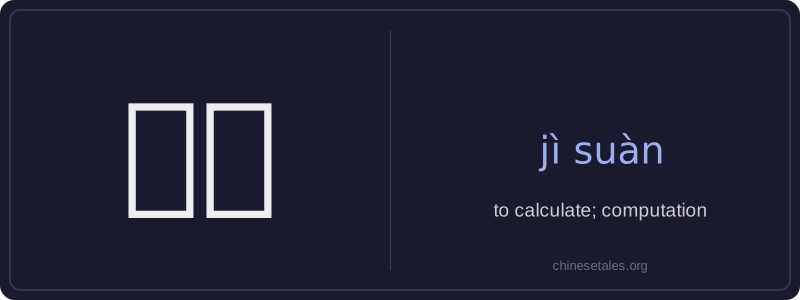
计算 (jì suàn) means 'to calculate' or 'computation' and functions as both a verb and a noun. The first character 计 (jì) means 'to plan, to consider, or to reckon', while the second character 算 (suàn) means 'to compute, to figure, or to count'. Together, they form a compound that emphasizes the mental or mechanical process of determining a numerical result — whether done by hand, calculator, or computer. It is widely used in academic, technical, financial, and everyday contexts involving numbers, measurements, or logical reasoning.
This word appears frequently in mathematics, science, engineering, and daily life — for example, when estimating costs, solving equations, analyzing data, or programming algorithms. As a noun, it often appears in compounds like 计算机 (jì suàn jī, 'computer') or 计算能力 (jì suàn néng lì, 'computational ability'). Unlike more casual terms like 算 (suàn) alone, 计算 carries a formal, precise connotation and is rarely used in idiomatic or figurative expressions.
Example Sentences
Related Words
背后
背后 literally means 'back + behind' and functions
认同
‘认同’ (tóng rèn) is a verb meaning ‘to ident
不对
不对 (bù duì) literally combines 不 (bù), meani
中学
'Zhōngxué' literally combines 'zhōng' (middle)
见面
见面 literally means 'see face' — combining 见 (t
面条
‘面条’ (miàn tiáo) literally means ‘flour str
外语
‘外语’ literally means ‘outside language’ —
认可
认可 (rèn kě) is a formal, transitive verb meani