Word Explanation
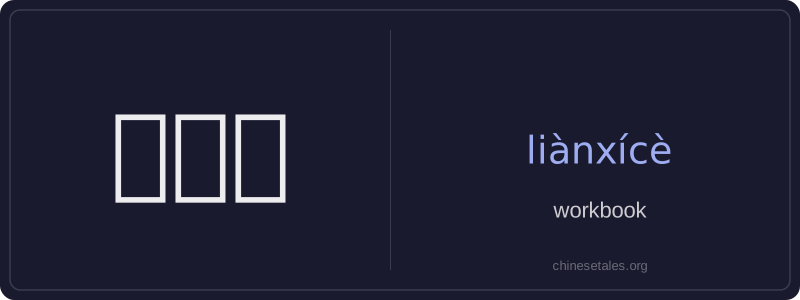
练习册 (liànxícè) is a compound noun meaning 'workbook' — a printed booklet containing exercises for practice, commonly used in Chinese education. The character 练 (liàn) means 'to practice' or 'to train', 习 (xí) means 'to study' or 'to review', and 册 (cè) means 'booklet' or 'volume'. Together, they literally convey 'a booklet for practicing and reviewing', emphasizing its functional purpose rather than just being a book. It’s distinct from textbooks (教科书) because it focuses on drills, fill-in-the-blank questions, matching tasks, and other active learning activities.
Students use 练习册 daily in school subjects like math, Chinese language, and English. Teachers assign pages as homework, and parents often buy supplementary workbooks for extra practice. Unlike digital apps, a 练习册 is always physical — bound, paginated, and meant to be written in. It’s an essential part of the Chinese academic routine, especially in primary and middle school, where repetition and handwriting are emphasized for mastery.
Example Sentences
Related Words
背后
背后 literally means 'back + behind' and functions
认同
‘认同’ (tóng rèn) is a verb meaning ‘to ident
不对
不对 (bù duì) literally combines 不 (bù), meani
中学
'Zhōngxué' literally combines 'zhōng' (middle)
见面
见面 literally means 'see face' — combining 见 (t
面条
‘面条’ (miàn tiáo) literally means ‘flour str
外语
‘外语’ literally means ‘outside language’ —
认可
认可 (rèn kě) is a formal, transitive verb meani