Word Explanation
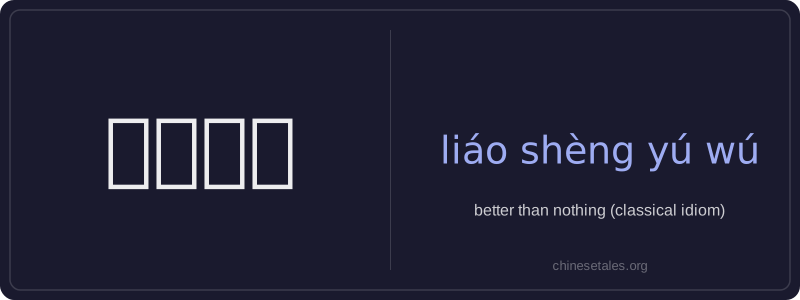
‘聊胜于无’ is a classical four-character idiom meaning ‘better than nothing’—it expresses that something, though small, inadequate, or imperfect, still has some value or utility where there would otherwise be none. Literally, 聊 means ‘slightly’ or ‘barely’, 胜 means ‘to surpass’ or ‘to be superior’, 于 is a preposition meaning ‘than’, and 无 means ‘nothing’ or ‘absence’. Together, the phrase conveys the idea of barely surpassing total absence—hence its pragmatic, slightly resigned tone.
This idiom is commonly used in everyday spoken and written Chinese to soften disappointment or acknowledge modest gains: for example, when receiving a small gift, an incomplete solution, or a partial answer. It carries a neutral-to-mildly humble register—not sarcastic, but gently realistic. While rooted in classical language, it remains fully current and natural in modern usage, especially in conversational contexts where understatement is valued.
Example Sentences
Related Words
背后
背后 literally means 'back + behind' and functions
认同
‘认同’ (tóng rèn) is a verb meaning ‘to ident
不对
不对 (bù duì) literally combines 不 (bù), meani
中学
'Zhōngxué' literally combines 'zhōng' (middle)
见面
见面 literally means 'see face' — combining 见 (t
面条
‘面条’ (miàn tiáo) literally means ‘flour str
外语
‘外语’ literally means ‘outside language’ —
认可
认可 (rèn kě) is a formal, transitive verb meani