Word Explanation
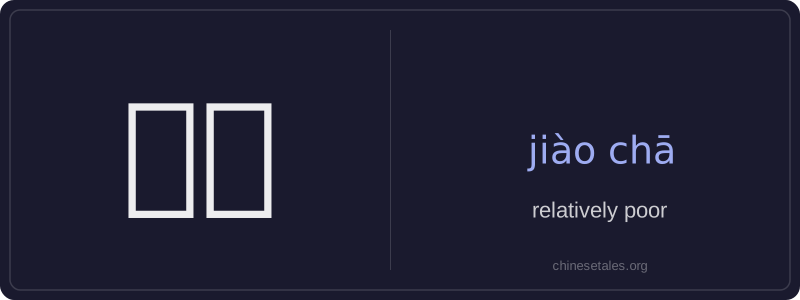
'较差' is an adjective meaning 'relatively poor' or 'below average'—it expresses a comparative judgment, not absolute deficiency. The first character 较 (jiào) means 'relatively' or 'comparatively', functioning like an adverb modifying the following adjective. The second character 差 (chā) means 'poor', 'inferior', or 'substandard'. Together, they form a fixed two-character adjective used to indicate that something ranks lower than a standard, expectation, or comparison point—often in objective evaluations like performance, quality, health, or ability.
This term appears frequently in formal and semi-formal contexts: medical reports ('lung function is relatively poor'), academic feedback ('writing skills are relatively weak'), or product reviews ('battery life is relatively short'). It avoids harshness—saying '较差' is more diplomatic than '很差' (very poor)—and always implies a basis of comparison, even if unstated (e.g., compared to peers, norms, or prior results).
Example Sentences
Related Words
面条
‘面条’ (miàn tiáo) literally means ‘flour str
背后
背后 literally means 'back + behind' and functions
认同
‘认同’ (tóng rèn) is a verb meaning ‘to ident
不对
不对 (bù duì) literally combines 不 (bù), meani
中学
'Zhōngxué' literally combines 'zhōng' (middle)
见面
见面 literally means 'see face' — combining 见 (t
外语
‘外语’ literally means ‘outside language’ —
认为
‘认为’ (rèn wéi) is a transitive verb meaning