Word Explanation
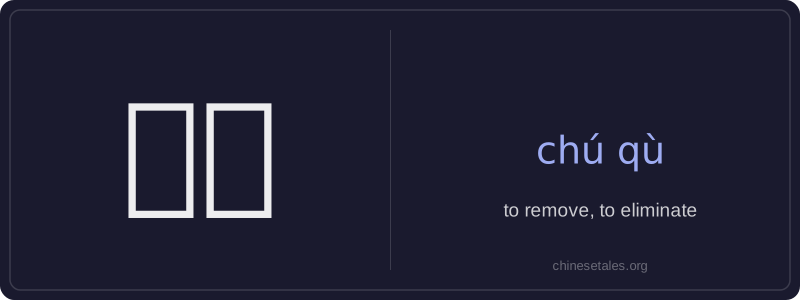
除去 (chú qù) is a transitive verb meaning 'to remove', 'to eliminate', or 'to get rid of' something unwanted, unnecessary, or harmful. The first character 除 (chú) carries the core meaning of 'to remove' or 'to eliminate', often appearing in formal or written contexts (e.g., 除非 'unless', 革除 'to dismiss'). The second character 去 (qù) reinforces the sense of 'going away' or 'departure', making the compound emphasize complete removal from a state, place, or condition. Together, they form a slightly formal but commonly used verb in both spoken and written Chinese.
This word is frequently used in contexts involving physical removal (e.g., removing stains), abstract elimination (e.g., eliminating errors or risks), or exclusion (e.g., 'except for'). It can take direct objects without particles like 把 or 被, and often appears in instructions, scientific writing, or official announcements. Unlike colloquial alternatives like 拿掉 or 去掉, 除去 tends to sound more precise and measured — suitable for describing deliberate, thorough removal.
Example Sentences
Related Words
认同
‘认同’ (tóng rèn) is a verb meaning ‘to ident
面条
‘面条’ (miàn tiáo) literally means ‘flour str
背后
背后 literally means 'back + behind' and functions
认为
‘认为’ (rèn wéi) is a transitive verb meaning
不对
不对 (bù duì) literally combines 不 (bù), meani
中学
'Zhōngxué' literally combines 'zhōng' (middle)
见面
见面 literally means 'see face' — combining 见 (t
外语
‘外语’ literally means ‘outside language’ —