Word Explanation
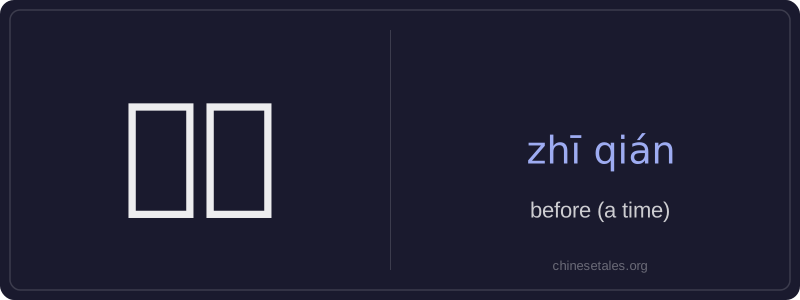
之前 (zhī qián) is a time-related preposition meaning 'before' — specifically, before a particular point or period in time. It is composed of 之 (zhī), a classical possessive or connective particle often used in formal or written Chinese, and 前 (qián), meaning 'front' or 'before' in spatial and temporal senses. Together, they form a fixed compound indicating anteriority in time — always referring to a moment or event that precedes another clearly stated or contextually understood time reference.
This word is commonly used in both spoken and written Chinese, though it sounds slightly more formal or precise than the colloquial alternative 以前 (yǐqián). It typically follows a time expression (e.g., 星期一之前, 会议之前) or a noun phrase denoting an event (e.g., 出发之前, 考试之前), and functions as a prepositional phrase modifying verbs or entire clauses. Unlike 以前, which can stand alone as an adverb ('previously'), 之前 must be attached to a specific temporal anchor.
Example Sentences
Related Words
认同
‘认同’ (tóng rèn) is a verb meaning ‘to ident
面条
‘面条’ (miàn tiáo) literally means ‘flour str
背后
背后 literally means 'back + behind' and functions
认为
‘认为’ (rèn wéi) is a transitive verb meaning
不对
不对 (bù duì) literally combines 不 (bù), meani
中学
'Zhōngxué' literally combines 'zhōng' (middle)
见面
见面 literally means 'see face' — combining 见 (t
外语
‘外语’ literally means ‘outside language’ —