Word Explanation
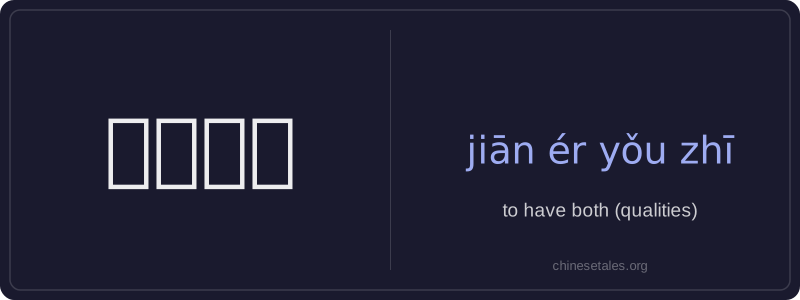
‘兼而有之’ is a classical four-character idiom meaning 'to possess both (qualities, traits, or features) simultaneously.' Literally, 兼 means 'to combine' or 'to hold concurrently,' 而 serves as a grammatical conjunction linking actions or states, 有 means 'to have,' and 之 is a pronoun meaning 'them/it' — together forming a compact expression for dual possession. It emphasizes that two seemingly contrasting or distinct attributes coexist in one person, thing, or situation.
This phrase is commonly used in formal writing, literary contexts, or thoughtful speech to highlight balance or complexity — for instance, describing someone who is both gentle and decisive, or a policy that achieves efficiency and fairness. It carries a slightly elevated, refined tone and rarely appears in casual conversation. While it can describe tangible things, it most often refers to abstract qualities like virtues, emotions, or characteristics.
Example Sentences
Related Words
认同
‘认同’ (tóng rèn) is a verb meaning ‘to ident
面条
‘面条’ (miàn tiáo) literally means ‘flour str
背后
背后 literally means 'back + behind' and functions
认为
‘认为’ (rèn wéi) is a transitive verb meaning
不对
不对 (bù duì) literally combines 不 (bù), meani
中学
'Zhōngxué' literally combines 'zhōng' (middle)
见面
见面 literally means 'see face' — combining 见 (t
外语
‘外语’ literally means ‘outside language’ —