Word Explanation
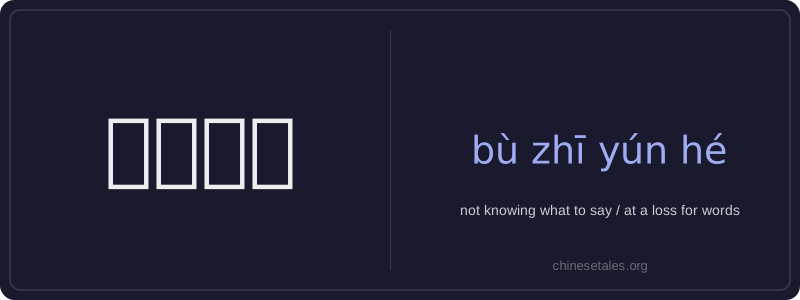
‘不知云何’ is a classical and literary expression meaning 'not knowing what to say' or 'at a loss for words'. It conveys deep hesitation, bewilderment, or emotional overwhelm—often when someone is speechless due to shock, embarrassment, admiration, or sorrow. Though composed of four common characters (bù ‘not’, zhī ‘to know’, yún ‘to say/speak’, hé ‘what’), the phrase functions as a fixed, idiomatic unit and is rarely parsed literally in modern usage.
This expression appears most frequently in written Chinese—especially in literature, formal speeches, or poetic dialogue—and is seldom used in casual spoken conversation. It carries a refined, slightly archaic tone and often signals heightened emotion or moral gravity. Learners should note that it is not a verb phrase but an interjection-like utterance, typically placed at the beginning or end of a sentence to express wordless reaction.
Example Sentences
Related Words
认同
‘认同’ (tóng rèn) is a verb meaning ‘to ident
面条
‘面条’ (miàn tiáo) literally means ‘flour str
背后
背后 literally means 'back + behind' and functions
认为
‘认为’ (rèn wéi) is a transitive verb meaning
不对
不对 (bù duì) literally combines 不 (bù), meani
中学
'Zhōngxué' literally combines 'zhōng' (middle)
见面
见面 literally means 'see face' — combining 见 (t
外语
‘外语’ literally means ‘outside language’ —