Word Explanation
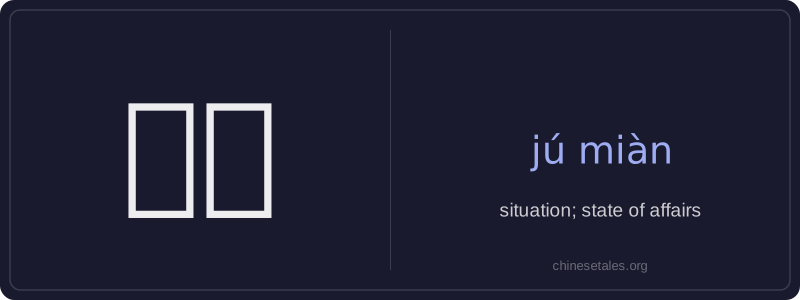
‘局面’ literally combines ‘局’ (jú), meaning ‘a situation, a board game setup, or a bounded context’, and ‘面’ (miàn), meaning ‘aspect, surface, or face’. Together, they form a noun describing the overall state or condition of a situation — especially one that is complex, dynamic, or requires strategic awareness. It often implies how things stand at a given moment, including relationships, power dynamics, or progress in a project or conflict.
This word is commonly used in formal, written, or analytical contexts — such as news reports, business meetings, or political commentary — to assess current conditions. While it can describe neutral or positive states (e.g., an improving situation), it’s frequently paired with verbs like ‘扭转’ (to reverse) or ‘稳定’ (to stabilize), suggesting that the situation may be challenging or unstable. Unlike the more casual ‘情况’ (qíngkuàng), ‘局面’ carries a sense of scope, structure, and interplay among multiple factors.
Example Sentences
Related Words
认同
‘认同’ (tóng rèn) is a verb meaning ‘to ident
面条
‘面条’ (miàn tiáo) literally means ‘flour str
背后
背后 literally means 'back + behind' and functions
认为
‘认为’ (rèn wéi) is a transitive verb meaning
不对
不对 (bù duì) literally combines 不 (bù), meani
中学
'Zhōngxué' literally combines 'zhōng' (middle)
见面
见面 literally means 'see face' — combining 见 (t
外语
‘外语’ literally means ‘outside language’ —