Word Explanation
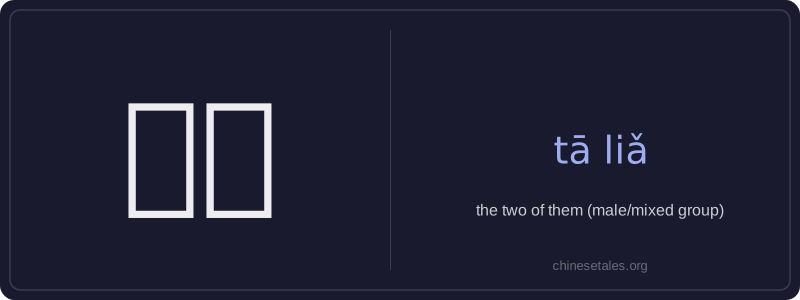
‘他俩’ is a colloquial pronoun meaning ‘the two of them’, specifically referring to two people where at least one is male (e.g., two men, or a man and a woman). It combines the third-person singular pronoun 他 (tā, ‘he’) with 俩 (liǎ), a contraction of 两个 (liǎng gè, ‘two [of]’), which functions as a measure-word-based plural marker. Unlike formal written Chinese—which would use 他们 (tāmen) for mixed or male groups—the form 他俩 is informal, spoken, and emphasizes exactly two individuals.
This expression is common in everyday conversation, especially when recounting shared actions, relationships, or plans: e.g., describing who went somewhere together, who agreed on something, or who shares a habit. It carries no grammatical gender marking beyond the implied presence of a male, and it cannot refer to two females (for which 她俩 tā liǎ is used instead). While 他俩 sounds identical to 他俩 when spoken, the character 俩 always signals ‘two’—never ‘all’ or ‘many’—making it precise and contextually grounded.
Example Sentences
Related Words
认同
‘认同’ (tóng rèn) is a verb meaning ‘to ident
面条
‘面条’ (miàn tiáo) literally means ‘flour str
背后
背后 literally means 'back + behind' and functions
认为
‘认为’ (rèn wéi) is a transitive verb meaning
不对
不对 (bù duì) literally combines 不 (bù), meani
中学
'Zhōngxué' literally combines 'zhōng' (middle)
见面
见面 literally means 'see face' — combining 见 (t
外语
‘外语’ literally means ‘outside language’ —