Word Explanation
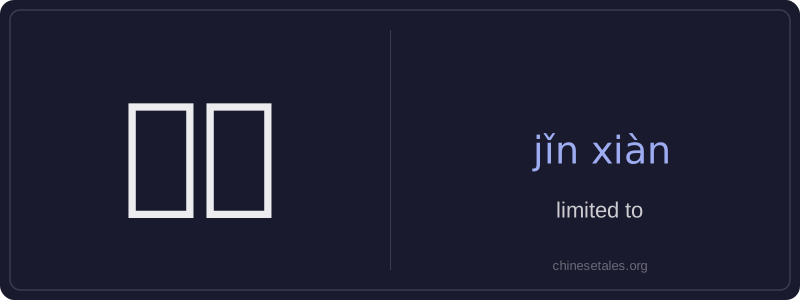
仅限 is a two-character prepositional phrase meaning 'limited to' or 'restricted to.' The first character 仅 (jǐn) means 'only' or 'merely,' emphasizing exclusivity and narrow scope; the second character 限 (xiàn) means 'to limit' or 'restriction.' Together, they form a concise, formal expression used to specify strict boundaries—often in official notices, rules, or instructions. It always precedes a noun or noun phrase and functions similarly to English prepositions like 'for' or 'to' in restrictive contexts (e.g., 'for staff only').
This phrase is common in public signage, membership policies, event invitations, and digital interfaces—especially where access, eligibility, or usage rights are narrowly defined. It carries a formal, slightly authoritative tone and is rarely used in casual speech. While grammatically it resembles a verb phrase, its syntactic role is consistently prepositional: it introduces the sole group, place, time, or condition to which something applies.
Example Sentences
Related Words
认同
‘认同’ (tóng rèn) is a verb meaning ‘to ident
面条
‘面条’ (miàn tiáo) literally means ‘flour str
背后
背后 literally means 'back + behind' and functions
认为
‘认为’ (rèn wéi) is a transitive verb meaning
不对
不对 (bù duì) literally combines 不 (bù), meani
中学
'Zhōngxué' literally combines 'zhōng' (middle)
见面
见面 literally means 'see face' — combining 见 (t
外语
‘外语’ literally means ‘outside language’ —