Word Explanation
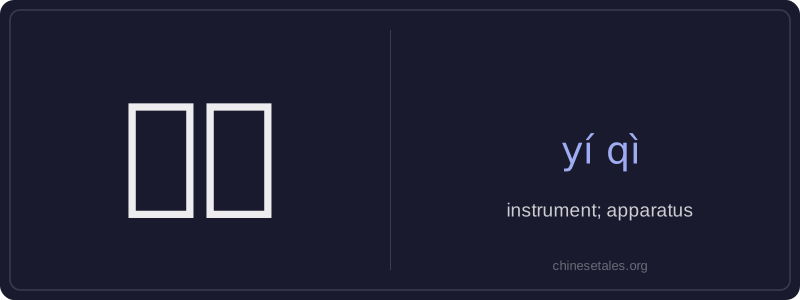
‘仪器’ (yí qì) is a compound noun meaning ‘instrument’ or ‘apparatus’—a device designed for precise measurement, analysis, or operation, especially in scientific, medical, or technical settings. The first character, 仪 (yí), originally means ‘ceremony’ or ‘ritual,’ but in modern compounds it carries connotations of ‘measurement,’ ‘observation,’ or ‘formal function’ (as in 仪表 ‘meter’ or 仪器 ‘measuring instrument’). The second character, 器 (qì), means ‘utensil,’ ‘vessel,’ or ‘tool,’ emphasizing physical structure and functional purpose. Together, 仪器 highlights both the precision-oriented role and tangible design of specialized equipment.
This word is commonly used in contexts like laboratories, hospitals, engineering, and education—e.g., measuring blood pressure, analyzing chemical samples, or calibrating sensors. It typically refers to relatively sophisticated, often electronic or mechanical devices—not everyday tools like knives or pens. While similar to 工具 (gōngjù, ‘tool’), 仪器 implies higher accuracy, calibration, and technical specificity.
Example Sentences
Related Words
认同
‘认同’ (tóng rèn) is a verb meaning ‘to ident
面条
‘面条’ (miàn tiáo) literally means ‘flour str
背后
背后 literally means 'back + behind' and functions
认为
‘认为’ (rèn wéi) is a transitive verb meaning
不对
不对 (bù duì) literally combines 不 (bù), meani
中学
'Zhōngxué' literally combines 'zhōng' (middle)
见面
见面 literally means 'see face' — combining 见 (t
外语
‘外语’ literally means ‘outside language’ —