Word Explanation
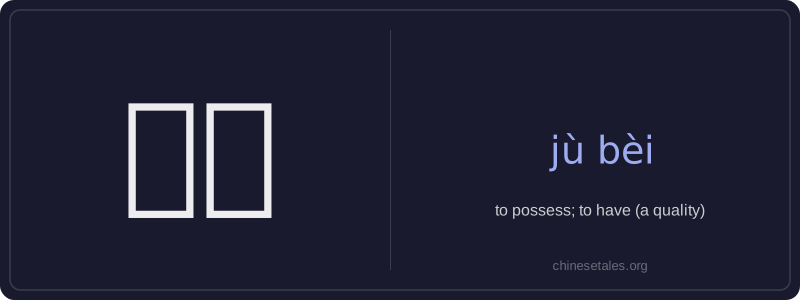
具备 (jù bèi) is a formal, transitive verb meaning 'to possess' or 'to have (a quality, ability, condition, or qualification).' It emphasizes that something—often an abstract trait like skill, knowledge, readiness, or suitability—is fully present and available for use. The character 具 means 'to have' or 'to possess,' while 备 means 'to prepare' or 'to be ready'; together, they convey the idea of having something fully prepared or inherently available—not just temporarily or superficially.
This word is commonly used in written Chinese, official documents, academic contexts, job descriptions, and formal speech. It often appears with nouns indicating qualities (e.g., 具备经验 'has experience', 具备条件 'meets the conditions') and frequently follows subjects such as people, organizations, or systems. Unlike colloquial verbs like 有 (yǒu), 具备 carries a stronger sense of adequacy, sufficiency, and readiness for a specific purpose or standard.
Example Sentences
Related Words
认同
‘认同’ (tóng rèn) is a verb meaning ‘to ident
面条
‘面条’ (miàn tiáo) literally means ‘flour str
背后
背后 literally means 'back + behind' and functions
认为
‘认为’ (rèn wéi) is a transitive verb meaning
不对
不对 (bù duì) literally combines 不 (bù), meani
中学
'Zhōngxué' literally combines 'zhōng' (middle)
见面
见面 literally means 'see face' — combining 见 (t
外语
‘外语’ literally means ‘outside language’ —