Word Explanation
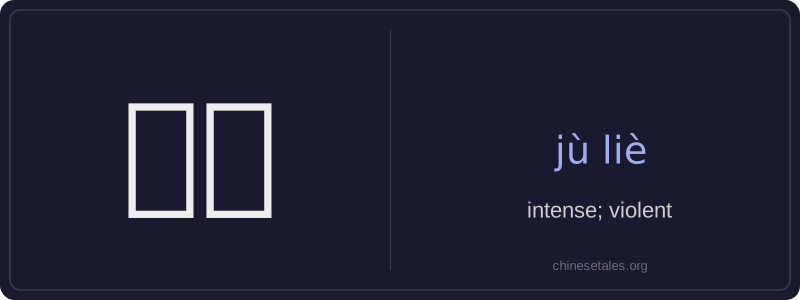
‘剧烈’ is an adjective meaning 'intense' or 'violent', describing something that happens with great force, speed, or severity. The character 剧 (jù) means 'dramatic', 'sudden', or 'extreme', while 烈 (liè) conveys 'fierce', 'fiery', or 'strong'. Together, they emphasize a high degree of intensity—commonly used to describe physical sensations (like pain or movement), natural phenomena (such as storms or earthquakes), or emotional reactions. It carries a slightly formal or literary tone and is more frequent in written Chinese and medical or scientific contexts than in casual speech.
The word typically modifies nouns (e.g., 剧烈疼痛, 剧烈运动) or follows verbs like ‘感到’ or ‘出现’. It’s rarely used predicatively without a complement (e.g., *他很剧烈 is ungrammatical; instead say 他反应很剧烈). Unlike colloquial intensifiers like 很厉害, 剧烈 suggests measurable, often disruptive intensity—not just subjective strength.
Example Sentences
Related Words
认同
‘认同’ (tóng rèn) is a verb meaning ‘to ident
面条
‘面条’ (miàn tiáo) literally means ‘flour str
背后
背后 literally means 'back + behind' and functions
认为
‘认为’ (rèn wéi) is a transitive verb meaning
不对
不对 (bù duì) literally combines 不 (bù), meani
中学
'Zhōngxué' literally combines 'zhōng' (middle)
见面
见面 literally means 'see face' — combining 见 (t
外语
‘外语’ literally means ‘outside language’ —