Word Explanation
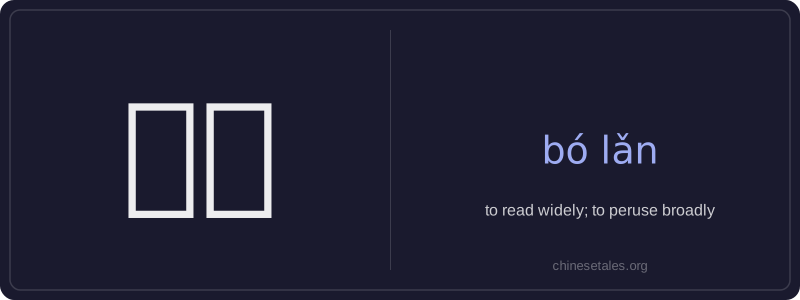
博览 (bó lǎn) is a formal, literary verb meaning 'to read widely' or 'to peruse broadly'—emphasizing breadth and diversity of reading rather than depth on a single topic. The character 博 (bó) means 'extensive', 'broad', or 'erudite', while 览 (lǎn) means 'to view', 'to survey', or 'to peruse'. Together, they evoke the image of casting one’s eyes across a wide range of texts, disciplines, or sources — like scanning a vast library or exploring many fields of knowledge.
This term appears frequently in academic, educational, and intellectual contexts — especially in phrases like 博览群书 (bó lǎn qún shū, 'to read extensively from many books') or in advice about cultivating broad learning. It carries a positive, aspirational connotation, often associated with scholars, lifelong learners, or well-rounded individuals. While grammatically a verb, 博览 rarely stands alone; it usually functions as part of a compound or appears after subjects indicating who is doing the reading (e.g., 他博览古今典籍).
Example Sentences
Related Words
认同
‘认同’ (tóng rèn) is a verb meaning ‘to ident
面条
‘面条’ (miàn tiáo) literally means ‘flour str
背后
背后 literally means 'back + behind' and functions
认为
‘认为’ (rèn wéi) is a transitive verb meaning
不对
不对 (bù duì) literally combines 不 (bù), meani
中学
'Zhōngxué' literally combines 'zhōng' (middle)
见面
见面 literally means 'see face' — combining 见 (t
外语
‘外语’ literally means ‘outside language’ —