Word Explanation
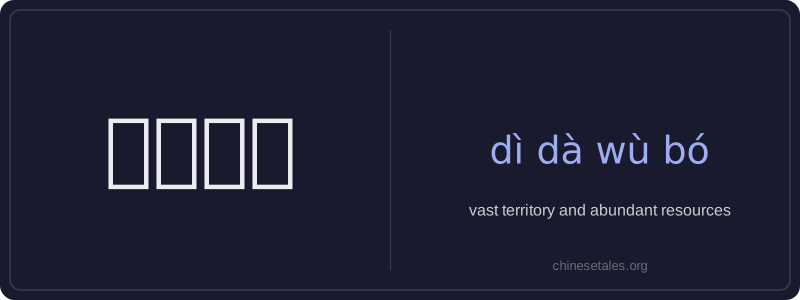
‘地大物博’ is a four-character idiom (chengyu) describing a country or region with vast land area and rich natural resources—such as minerals, forests, farmland, water, and wildlife. Literally, ‘地’ means ‘land/territory’, ‘大’ means ‘vast/large’, ‘物’ means ‘things/resources’, and ‘博’ means ‘abundant/extensive’. Together, they form a concise, elevated expression emphasizing scale and richness, commonly used in formal contexts like geography textbooks, news reports, or patriotic discourse.
This phrase carries positive connotations of national pride and self-sufficiency, but it’s not used to describe individuals or small-scale settings. It often appears in subject position (e.g., ‘中国地大物博’) or as a predicate after 是 or 以. While evocative, it’s descriptive rather than analytical—it highlights breadth, not sustainability, distribution, or development challenges.
Example Sentences
Related Words
认同
‘认同’ (tóng rèn) is a verb meaning ‘to ident
面条
‘面条’ (miàn tiáo) literally means ‘flour str
背后
背后 literally means 'back + behind' and functions
认为
‘认为’ (rèn wéi) is a transitive verb meaning
不对
不对 (bù duì) literally combines 不 (bù), meani
中学
'Zhōngxué' literally combines 'zhōng' (middle)
见面
见面 literally means 'see face' — combining 见 (t
外语
‘外语’ literally means ‘outside language’ —