Word Explanation
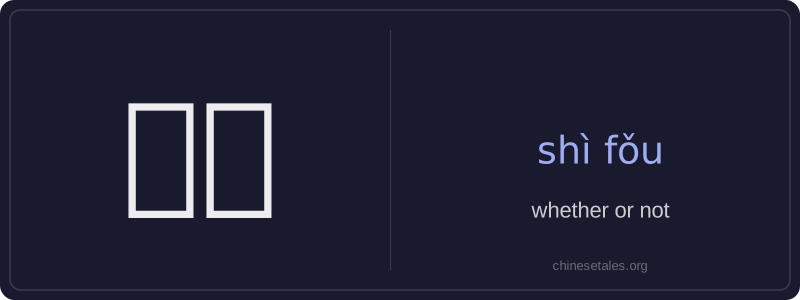
'是否' is a conjunction meaning 'whether or not' and functions as a single unit to introduce indirect questions or express uncertainty about a binary choice (yes/no). It combines the characters 是 (shì, 'yes' or 'to be') and 否 (fǒu, 'no' or 'not'), forming a compact, formal alternative to longer phrases like '是不是' or '有没有'. It is commonly used in written Chinese and formal speech—especially in questions embedded within statements, reported speech, or conditional clauses.
Unlike spoken alternatives such as '是不是', '是否' carries a neutral-to-formal register and avoids repetition of the verb. It typically appears before a verb or adjective phrase (e.g., 是否知道, 是否重要) and cannot stand alone as a sentence. While grammatically flexible, it rarely occurs at the very beginning of casual conversation; instead, it's preferred in contexts requiring clarity, precision, or politeness—such as official emails, surveys, academic writing, or polite inquiries.
Example Sentences
Related Words
认同
‘认同’ (tóng rèn) is a verb meaning ‘to ident
面条
‘面条’ (miàn tiáo) literally means ‘flour str
背后
背后 literally means 'back + behind' and functions
认为
‘认为’ (rèn wéi) is a transitive verb meaning
不对
不对 (bù duì) literally combines 不 (bù), meani
中学
'Zhōngxué' literally combines 'zhōng' (middle)
见面
见面 literally means 'see face' — combining 见 (t
外语
‘外语’ literally means ‘outside language’ —