Word Explanation
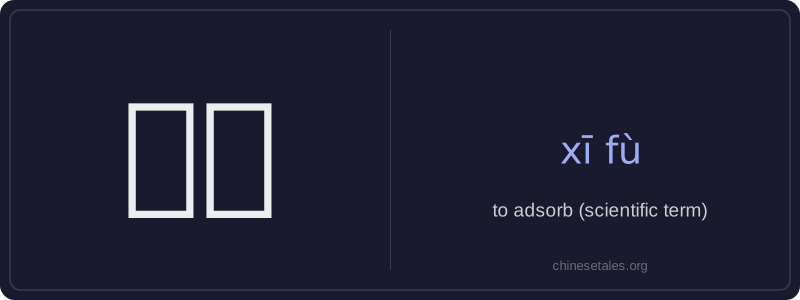
吸附 (xī fù) is a scientific verb meaning 'to adsorb'—a physical process where atoms, ions, or molecules from a gas, liquid, or dissolved solid adhere to the surface of a solid or liquid. The first character 吸 (xī) means 'to suck in' or 'to absorb', and the second character 附 (fù) means 'to attach' or 'to adhere'. Together, they emphasize surface-level attachment rather than full absorption into the bulk material (which would be 吸收, xīshōu). This term is commonly used in chemistry, environmental science, and materials engineering.
You’ll encounter 吸附 when discussing activated carbon filters removing pollutants from water or air, clay particles binding nutrients in soil, or plant roots interacting with minerals in the rhizosphere. It’s distinct from absorption (penetration into the interior) and is often reversible under changing conditions like temperature or concentration. In everyday contexts, it rarely appears outside technical or academic writing—native speakers usually rely on simpler verbs unless describing precise scientific phenomena.
Example Sentences
Related Words
认同
‘认同’ (tóng rèn) is a verb meaning ‘to ident
面条
‘面条’ (miàn tiáo) literally means ‘flour str
背后
背后 literally means 'back + behind' and functions
认为
‘认为’ (rèn wéi) is a transitive verb meaning
不对
不对 (bù duì) literally combines 不 (bù), meani
中学
'Zhōngxué' literally combines 'zhōng' (middle)
见面
见面 literally means 'see face' — combining 见 (t
外语
‘外语’ literally means ‘outside language’ —