Word Explanation
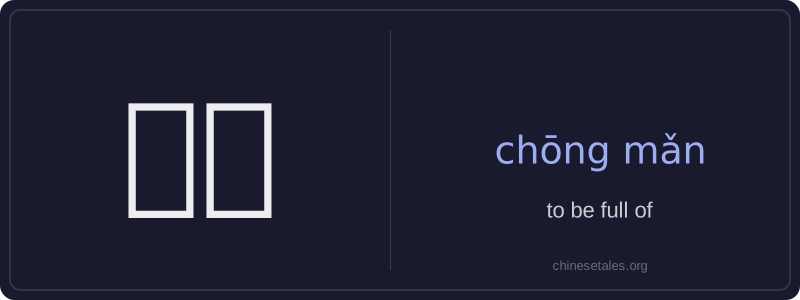
充满 (chōng mǎn) is a verb meaning 'to be full of' or 'to be filled with' — it describes a state where something is thoroughly permeated by a quality, emotion, substance, or energy. The character 充 means 'to fill' or 'to charge', and 满 means 'full' or 'complete'; together, they form an inseparable compound emphasizing abundance and saturation. It’s commonly used before abstract nouns like hope, joy, danger, curiosity, or tension — never with countable physical objects alone (e.g., you wouldn’t say *充满苹果*).
This word often appears in descriptive, literary, or emotionally expressive contexts — in writing, speeches, news reports, or everyday expressions of inner states. It typically follows the subject and precedes the noun it modifies (e.g., 房间充满阳光 — 'The room is filled with sunlight'). Unlike the simple verb 填满 (tián mǎn), which implies deliberate physical filling, 充满 carries a more natural, pervasive, or even intangible sense of presence.
Example Sentences
Related Words
背后
背后 literally means 'back + behind' and functions
认同
‘认同’ (tóng rèn) is a verb meaning ‘to ident
不对
不对 (bù duì) literally combines 不 (bù), meani
中学
'Zhōngxué' literally combines 'zhōng' (middle)
见面
见面 literally means 'see face' — combining 见 (t
面条
‘面条’ (miàn tiáo) literally means ‘flour str
外语
‘外语’ literally means ‘outside language’ —
无论谁
‘无论谁’ (wú lùn shéi) is a pronoun meaning