Word Explanation
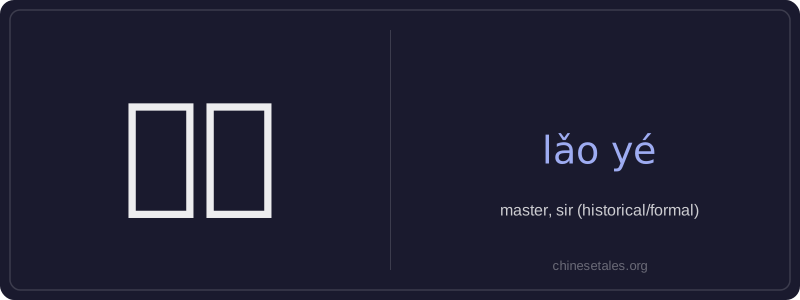
'Lǎo yé' is a historical and formal term of address meaning 'master' or 'sir', used primarily in pre-modern China to refer respectfully to the male head of a household, a nobleman, or a high-status man—especially by servants, subordinates, or commoners. The character 老 (lǎo) conveys seniority, respect, and authority, while 爷 (yé) is an honorific suffix denoting status and senior male rank, akin to 'lord' or 'gentleman'. Together, they form a compound that emphasizes both age-based reverence and social hierarchy.
This term appears frequently in classical literature, historical dramas, and period films—such as when a servant addresses his employer or a court official bows before a magistrate. It is not used in modern daily speech except for stylistic effect (e.g., role-play, satire, or theatrical performance). Unlike neutral terms like 先生 (xiānsheng), 老爷 carries strong connotations of feudal social structure and power imbalance.
Example Sentences
Related Words
背后
背后 literally means 'back + behind' and functions
认同
‘认同’ (tóng rèn) is a verb meaning ‘to ident
不对
不对 (bù duì) literally combines 不 (bù), meani
中学
'Zhōngxué' literally combines 'zhōng' (middle)
见面
见面 literally means 'see face' — combining 见 (t
面条
‘面条’ (miàn tiáo) literally means ‘flour str
外语
‘外语’ literally means ‘outside language’ —
无论谁
‘无论谁’ (wú lùn shéi) is a pronoun meaning