Word Explanation
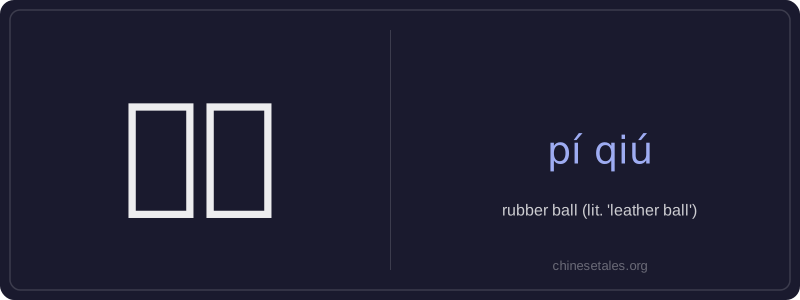
‘皮球’ literally means ‘leather ball’, but in modern Chinese it almost always refers to a lightweight, bouncy rubber ball—commonly used by children for play, physical education, or simple games like kicking or bouncing. Though the character 皮 (pí) historically meant ‘leather’, today it’s used broadly in compound words for elastic or outer-layer materials, and 球 (qiú) means ‘ball’. Together, 皮球 evokes a familiar, everyday object rather than a specific material composition.
This word is neutral in register and widely understood across age groups. It appears frequently in contexts involving childhood, sports education, and casual outdoor activity. Unlike more technical terms like 足球 (zúqiú, soccer ball) or 篮球 (lánqiú, basketball), 皮球 carries no formal sport association—it’s generic, playful, and often implies simplicity or informality. You’ll hear it in schools, parks, and family settings, especially when describing unstructured physical play or basic motor skill development.
Example Sentences
Related Words
背后
背后 literally means 'back + behind' and functions
认同
‘认同’ (tóng rèn) is a verb meaning ‘to ident
不对
不对 (bù duì) literally combines 不 (bù), meani
中学
'Zhōngxué' literally combines 'zhōng' (middle)
见面
见面 literally means 'see face' — combining 见 (t
面条
‘面条’ (miàn tiáo) literally means ‘flour str
外语
‘外语’ literally means ‘outside language’ —
认可
认可 (rèn kě) is a formal, transitive verb meani