Word Explanation
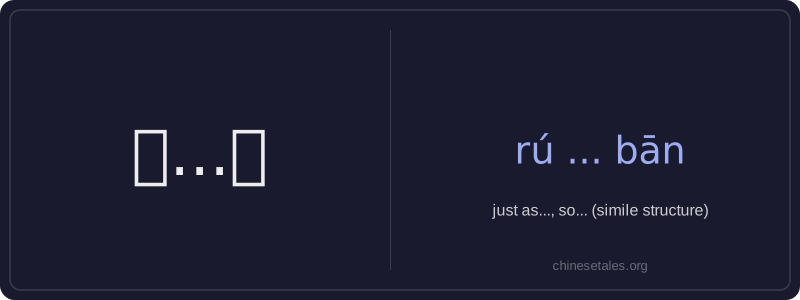
‘如…般’ is a literary simile structure meaning ‘just as…, so…’ or ‘like…’. It consists of the character 如 (rú), meaning ‘as’ or ‘like’, followed by a noun or noun phrase (the simile’s source), and ending with 般 (bān), meaning ‘kind’ or ‘sort’, which functions like ‘-like’ or ‘-wise’ in English. Together, they form an elegant, formal comparison — often used in writing, poetry, or expressive speech to evoke vivid imagery or emotional resonance.
This structure emphasizes similarity in quality, appearance, or feeling, rather than literal equivalence. It typically modifies a noun or verb phrase that follows — for example, ‘如春风般温暖’ (warm as a spring breeze). Unlike colloquial comparisons using 像…一样, 如…般 carries a refined, slightly classical tone and appears more frequently in descriptive or emotive contexts, especially when evoking natural phenomena, human qualities, or abstract states.
Example Sentences
Related Words
背后
背后 literally means 'back + behind' and functions
认同
‘认同’ (tóng rèn) is a verb meaning ‘to ident
不对
不对 (bù duì) literally combines 不 (bù), meani
中学
'Zhōngxué' literally combines 'zhōng' (middle)
见面
见面 literally means 'see face' — combining 见 (t
面条
‘面条’ (miàn tiáo) literally means ‘flour str
外语
‘外语’ literally means ‘outside language’ —
认可
认可 (rèn kě) is a formal, transitive verb meani