Word Explanation
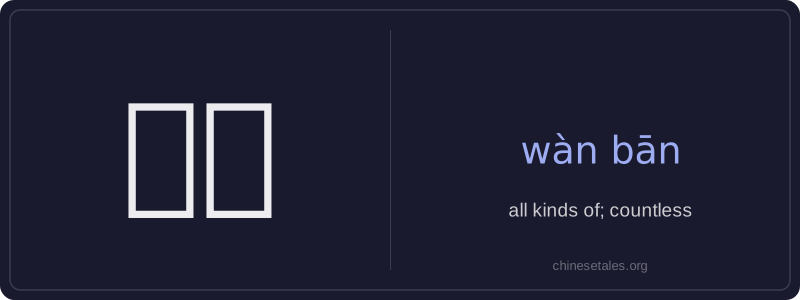
萬般 (wàn bān) is an adjective meaning 'all kinds of' or 'countless', emphasizing variety, intensity, or overwhelming abundance—often with emotional or qualitative weight. The character 萬 (wàn) literally means 'ten thousand', serving as a classical hyperbolic quantifier for 'innumerable'; 般 (bān) means 'kind', 'sort', or 'type', derived from its original sense of 'to resemble' or 'category'. Together, they form a fixed literary compound that conveys totality and richness—not just numerical quantity, but diversity and depth.
This phrase appears frequently in formal writing, poetry, idioms, and emotional expressions (e.g., describing feelings, difficulties, or beauties). It often modifies nouns directly or functions predicatively after 是 or in constructions like 萬般無奈 or 萬般滋味. Though grammatically adjectival, it rarely stands alone and usually requires contextual support—such as a noun it modifies or a verb it complements—to convey full meaning. It carries a slightly elevated, traditional register and is uncommon in casual speech.
Example Sentences
Related Words
背后
背后 literally means 'back + behind' and functions
认同
‘认同’ (tóng rèn) is a verb meaning ‘to ident
不对
不对 (bù duì) literally combines 不 (bù), meani
中学
'Zhōngxué' literally combines 'zhōng' (middle)
见面
见面 literally means 'see face' — combining 见 (t
面条
‘面条’ (miàn tiáo) literally means ‘flour str
外语
‘外语’ literally means ‘outside language’ —
认可
认可 (rèn kě) is a formal, transitive verb meani