Word Explanation
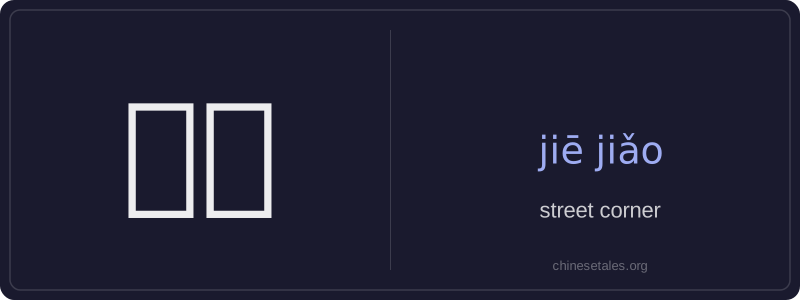
街角 (jiē jiǎo) literally combines 街 (jiē), meaning 'street' or 'road', and 角 (jiǎo), meaning 'corner' or 'angle'. Together, they refer specifically to the intersection point where two streets meet — the physical corner formed by their meeting. It’s a concrete, spatial term used in everyday navigation, directions, and descriptions of urban environments.
This word is neutral in register and commonly appears in spoken and written Chinese when giving locations ('Wait for me at the street corner'), describing scenes ('A small café on the street corner'), or narrating stories ('He stood alone at the street corner'). Unlike broader terms like 路口 (lùkǒu, 'intersection'), 街角 emphasizes the architectural or visual 'corner' itself — often evoking imagery of buildings, signage, or people gathering there. It’s frequently used with directional words (e.g., 街角右边, 'to the right of the street corner') or verbs of location (e.g., 在街角, 'at the street corner').
Example Sentences
Related Words
背后
背后 literally means 'back + behind' and functions
认同
‘认同’ (tóng rèn) is a verb meaning ‘to ident
不对
不对 (bù duì) literally combines 不 (bù), meani
中学
'Zhōngxué' literally combines 'zhōng' (middle)
见面
见面 literally means 'see face' — combining 见 (t
面条
‘面条’ (miàn tiáo) literally means ‘flour str
外语
‘外语’ literally means ‘outside language’ —
认为
‘认为’ (rèn wéi) is a transitive verb meaning