Word Explanation
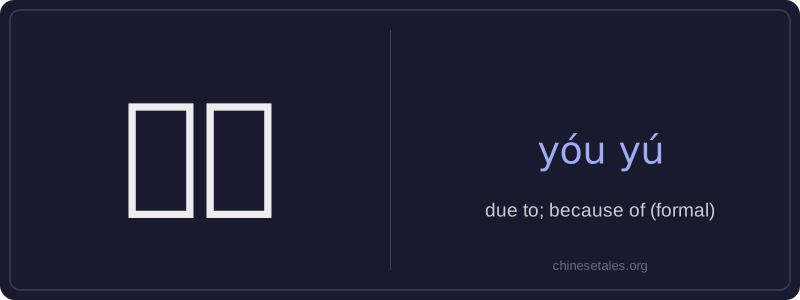
'由于' (yóu yú) is a formal preposition and conjunction meaning 'due to' or 'because of'. It introduces the cause or reason for a situation, event, or result — always placed before the cause, followed by the effect in the main clause. Though composed of two characters (由 'yóu', meaning 'from' or 'by', and 于 'yú', a classical particle indicating origin or basis), together they function as a fixed compound with no separable meaning. It is common in written Chinese, academic writing, news reports, and formal speech, but rarely used in casual conversation.
The structure is typically '由于 + [reason], + [result clause]'. The reason phrase is usually a noun phrase or short clause (e.g., '天气恶劣', '资金不足'), not a full verb phrase with subject–predicate structure. Unlike the more colloquial '因为', '由于' cannot stand alone as a sentence-initial conjunction introducing an independent reason clause; it must be embedded in a larger sentence where the consequence is clearly stated.
Example Sentences
Related Words
认同
‘认同’ (tóng rèn) is a verb meaning ‘to ident
面条
‘面条’ (miàn tiáo) literally means ‘flour str
背后
背后 literally means 'back + behind' and functions
认为
‘认为’ (rèn wéi) is a transitive verb meaning
不对
不对 (bù duì) literally combines 不 (bù), meani
中学
'Zhōngxué' literally combines 'zhōng' (middle)
见面
见面 literally means 'see face' — combining 见 (t
外语
‘外语’ literally means ‘outside language’ —