Word Explanation
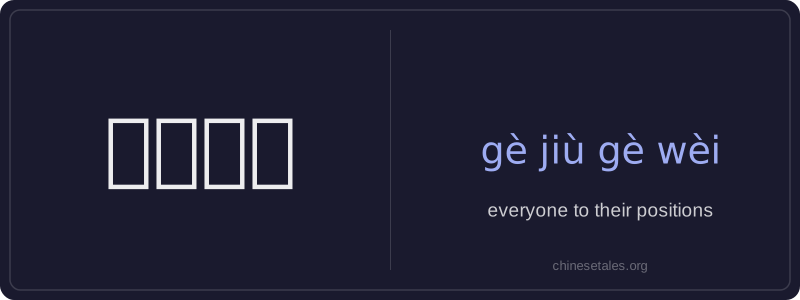
'Each to their own position' is a set phrase used to signal the start of an organized activity requiring participants to take their designated places. Literally, 各 (gè) means 'each' or 'respective', 就 (jiù) means 'to assume' or 'to take up', and 位 (wèi) means 'position' or 'place'. Together, the phrase conveys readiness and order — not just physical placement, but also mental or functional preparedness. It’s highly formulaic and rarely used outside structured group settings.
This expression is most common in sports, school activities, ceremonies, rehearsals, and workplace drills — anywhere clear roles and spatial arrangement matter. It carries a tone of authority and expectation, often spoken by a leader or organizer. Though grammatically a noun or interjection, it functions like a command and is seldom modified or embedded in complex clauses. Its rhythm and repetition make it easy to remember and effective for prompting immediate action.
Example Sentences
Related Words
认同
‘认同’ (tóng rèn) is a verb meaning ‘to ident
面条
‘面条’ (miàn tiáo) literally means ‘flour str
背后
背后 literally means 'back + behind' and functions
认为
‘认为’ (rèn wéi) is a transitive verb meaning
不对
不对 (bù duì) literally combines 不 (bù), meani
中学
'Zhōngxué' literally combines 'zhōng' (middle)
见面
见面 literally means 'see face' — combining 见 (t
外语
‘外语’ literally means ‘outside language’ —