Word Explanation
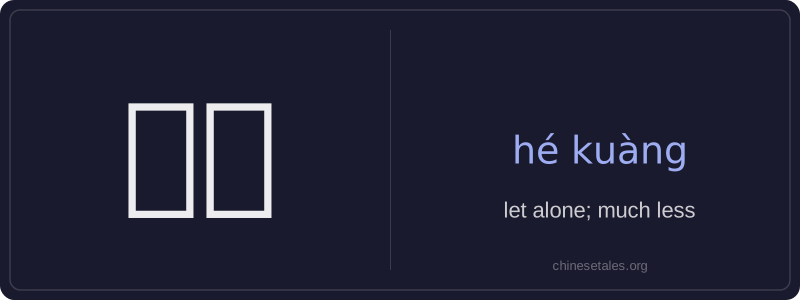
‘何况’ is a conjunction meaning ‘let alone’ or ‘much less’, used to introduce a stronger or more obvious case after a weaker or already-accepted one. It emphasizes that if the first statement is true or valid, then the second — being even more evident, extreme, or self-evident — must also be true. Literally, 何 (hé) means ‘what’ or ‘why’, and 况 (kuàng) means ‘moreover’ or ‘furthermore’; together they form an idiomatic expression signaling logical escalation.
This word commonly appears in spoken and written Chinese to strengthen arguments, express rhetorical emphasis, or highlight contrast in degree or probability. It typically follows a clause expressing a relatively mild, accepted, or conceded fact, and introduces a second clause that is even more compelling — often involving greater difficulty, higher cost, stronger emotion, or clearer logic. It’s frequently used in persuasion, explanation, or justification, especially when appealing to common sense or shared assumptions.
Example Sentences
Related Words
认同
‘认同’ (tóng rèn) is a verb meaning ‘to ident
面条
‘面条’ (miàn tiáo) literally means ‘flour str
背后
背后 literally means 'back + behind' and functions
认为
‘认为’ (rèn wéi) is a transitive verb meaning
不对
不对 (bù duì) literally combines 不 (bù), meani
中学
'Zhōngxué' literally combines 'zhōng' (middle)
见面
见面 literally means 'see face' — combining 见 (t
外语
‘外语’ literally means ‘outside language’ —