Word Explanation
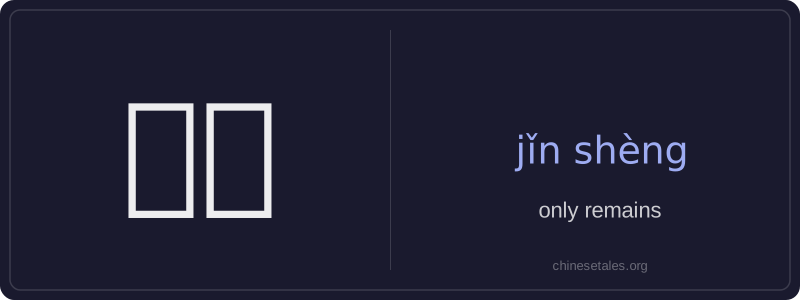
'仅剩' is an adverbial phrase meaning 'only remains' or 'only left', emphasizing that a very small quantity—often just one or a few—of something remains after most has been used, lost, or gone. The character 仅 (jǐn) means 'only' or 'merely', while 剩 (shèng) means 'to remain' or 'leftover'. Together, they form a compact, formal-sounding expression commonly used in written Chinese and careful spoken contexts—such as news reports, announcements, or descriptions of dwindling resources.
This phrase always modifies verbs (e.g., 剩下, 有, 留下) or quantified nouns and typically appears before the noun or verb it modifies. It carries a subtle tone of scarcity or urgency, often implying that action may be needed soon. Unlike casual alternatives like 还剩, 仅剩 sounds more precise and weighty, making it frequent in official notices, inventory updates, or environmental or economic discussions about depletion.
Example Sentences
Related Words
认同
‘认同’ (tóng rèn) is a verb meaning ‘to ident
面条
‘面条’ (miàn tiáo) literally means ‘flour str
背后
背后 literally means 'back + behind' and functions
认为
‘认为’ (rèn wéi) is a transitive verb meaning
不对
不对 (bù duì) literally combines 不 (bù), meani
中学
'Zhōngxué' literally combines 'zhōng' (middle)
见面
见面 literally means 'see face' — combining 见 (t
外语
‘外语’ literally means ‘outside language’ —