Word Explanation
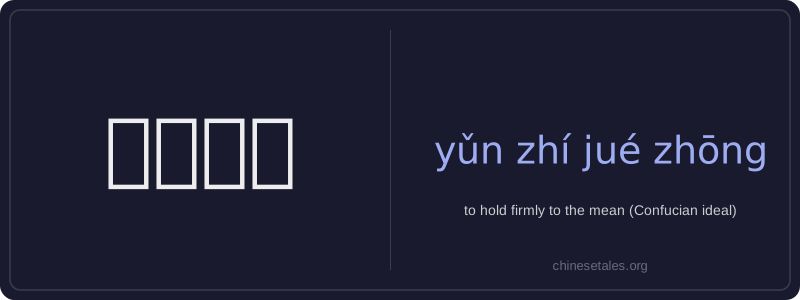
‘允执厥中’ is a classical Confucian phrase from the Book of Documents, expressing the ideal of holding firmly to the ‘mean’—not excess nor deficiency, but balanced, impartial, and virtuous conduct. Literally, 允 (yǔn) means ‘to approve’ or ‘genuinely’, 执 (zhí) means ‘to hold’ or ‘to adhere to’, 厥 (jué) is an archaic pronoun meaning ‘that’ or ‘its’, and 中 (zhōng) refers to the ‘mean’ or ‘center’—the moral and behavioral midpoint advocated by Confucius as the highest standard of wisdom and virtue.
This phrase is not used in everyday speech but appears in scholarly discussions of Confucian ethics, political philosophy, and traditional education. It reflects a deep cultural commitment to harmony, moderation, and principled judgment—especially in leadership and self-cultivation. While rarely spoken aloud, it carries significant weight in academic, philosophical, and ceremonial contexts, often evoking ideals of fairness, restraint, and sagely equilibrium.
Example Sentences
Related Words
认同
‘认同’ (tóng rèn) is a verb meaning ‘to ident
面条
‘面条’ (miàn tiáo) literally means ‘flour str
背后
背后 literally means 'back + behind' and functions
认为
‘认为’ (rèn wéi) is a transitive verb meaning
不对
不对 (bù duì) literally combines 不 (bù), meani
中学
'Zhōngxué' literally combines 'zhōng' (middle)
见面
见面 literally means 'see face' — combining 见 (t
外语
‘外语’ literally means ‘outside language’ —