Word Explanation
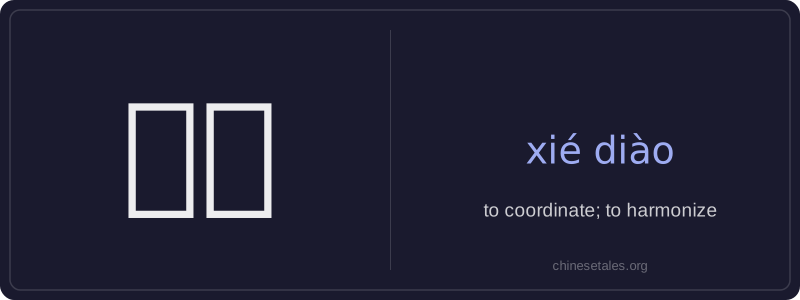
'谐调' (xié diào) is a verb meaning 'to coordinate' or 'to harmonize', emphasizing smooth, balanced alignment among elements—whether people, systems, sounds, colors, or actions. The character 谐 (xié) conveys harmony, agreement, and pleasant compatibility (as in 和谐 hétí), while 调 (diào) means 'to adjust' or 'to regulate', often implying fine-tuning to achieve balance. Together, they suggest an active process of bringing parts into cohesive, mutually supportive alignment—not just mechanical coordination but aesthetic or functional consonance.
This word is commonly used in formal, technical, or descriptive contexts: project management, music production, interior design, ecological conservation, or team collaboration. It implies intentionality and sensitivity—less about rigid scheduling (like 安排 ānpái) and more about achieving organic synergy. While grammatically it functions as a transitive verb (e.g., 谐调各方意见), it’s also frequently used in passive or resultative constructions (e.g., 达到谐调, 实现谐调). It carries a slightly literary or professional register and is rarely used in casual daily speech.
Example Sentences
Related Words
认同
‘认同’ (tóng rèn) is a verb meaning ‘to ident
面条
‘面条’ (miàn tiáo) literally means ‘flour str
背后
背后 literally means 'back + behind' and functions
认为
‘认为’ (rèn wéi) is a transitive verb meaning
不对
不对 (bù duì) literally combines 不 (bù), meani
中学
'Zhōngxué' literally combines 'zhōng' (middle)
见面
见面 literally means 'see face' — combining 见 (t
外语
‘外语’ literally means ‘outside language’ —