Word Explanation
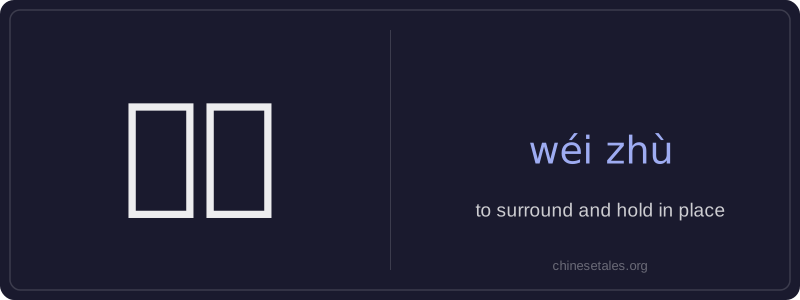
围住 (wéi zhù) is a compound verb meaning 'to surround and hold in place' — it implies completely encircling someone or something so that escape or movement is blocked. The first character 围 (wéi) means 'to surround' or 'to encircle', while the second character 住 (zhù) functions as a resultative complement indicating 'to stop', 'to hold steady', or 'to fix in position'. Together, they express not just encirclement but also containment and immobilization.
This verb is commonly used in contexts involving control, capture, or restriction — especially in descriptions of animals being cornered (e.g., by hunters or wildlife officers), crowds surrounding a person, or security personnel isolating a suspect. It carries a sense of intentionality and effectiveness: if someone is 围住, they are fully enclosed with no easy exit. It’s more forceful and definitive than simply 围着 (wéi zhe, 'surrounding') and often appears in narrative or news-style Chinese describing decisive action.
Example Sentences
Related Words
背后
背后 literally means 'back + behind' and functions
认同
‘认同’ (tóng rèn) is a verb meaning ‘to ident
面条
‘面条’ (miàn tiáo) literally means ‘flour str
认为
‘认为’ (rèn wéi) is a transitive verb meaning
无论谁
‘无论谁’ (wú lùn shéi) is a pronoun meaning
不对
不对 (bù duì) literally combines 不 (bù), meani
中学
'Zhōngxué' literally combines 'zhōng' (middle)
见面
见面 literally means 'see face' — combining 见 (t