Word Explanation
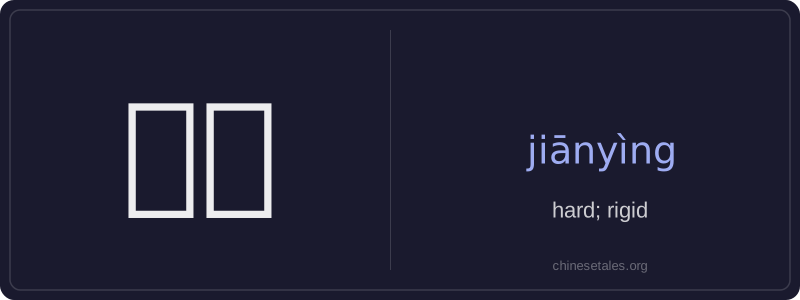
坚硬 (jiānyìng) is an adjective meaning 'hard' or 'rigid', describing something that resists pressure, bending, or deformation — like stone, metal, or dense wood. The first character 坚 (jiān) means 'firm', 'strong', or 'resolute', often implying durability and integrity; the second character 硬 (yìng) means 'hard', 'stiff', or 'unyielding', emphasizing physical resistance. Together, they form a compound that intensifies the sense of unyielding solidity — stronger and more formal than 硬 alone, and more physically concrete than 坚 alone.
This word is commonly used to describe natural materials (e.g., rock, teeth, shells), manufactured objects (e.g., steel, ceramic), or metaphorical contexts where toughness is emphasized (e.g., a 'hardened' attitude). It’s neutral in register but slightly literary; you’ll see it in descriptive writing, scientific texts, and everyday speech when precision about texture or durability matters.
Example Sentences
Related Words
背后
背后 literally means 'back + behind' and functions
认同
‘认同’ (tóng rèn) is a verb meaning ‘to ident
面条
‘面条’ (miàn tiáo) literally means ‘flour str
认为
‘认为’ (rèn wéi) is a transitive verb meaning
无论谁
‘无论谁’ (wú lùn shéi) is a pronoun meaning
不对
不对 (bù duì) literally combines 不 (bù), meani
中学
'Zhōngxué' literally combines 'zhōng' (middle)
见面
见面 literally means 'see face' — combining 见 (t