Word Explanation
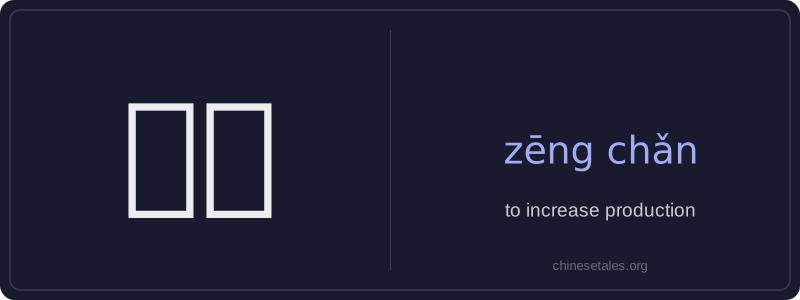
增产 literally means 'to increase production' — 增 (zēng) means 'to increase' or 'to add', and 产 (chǎn) means 'production' or 'to produce'. Together, they form a verb describing the act of raising output, especially in agriculture, manufacturing, or resource management. It is commonly used in formal and semi-formal contexts, such as government reports, news articles, and agricultural extension materials.
This term emphasizes measurable growth in yield or output, often achieved through improved techniques, better seeds, fertilizers, or technology. While it can apply to industrial settings, it appears most frequently when discussing crop yields, livestock output, or fisheries — making it especially relevant in rural development and food security discussions. It is rarely used for abstract or personal 'production' (e.g., ideas or art), and never functions as a noun on its own without additional particles like 的 or 性.
Example Sentences
Related Words
面条
‘面条’ (miàn tiáo) literally means ‘flour str
背后
背后 literally means 'back + behind' and functions
认同
‘认同’ (tóng rèn) is a verb meaning ‘to ident
无论谁
‘无论谁’ (wú lùn shéi) is a pronoun meaning
中学
'Zhōngxué' literally combines 'zhōng' (middle)
认为
‘认为’ (rèn wéi) is a transitive verb meaning
认可
认可 (rèn kě) is a formal, transitive verb meani
不对
不对 (bù duì) literally combines 不 (bù), meani