Word Explanation
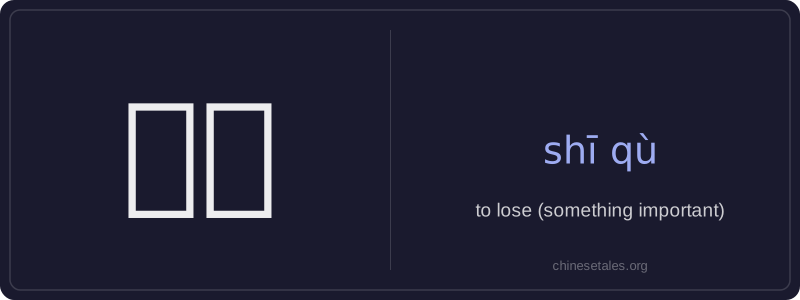
失去 (shī qù) is a compound verb meaning 'to lose'—especially something valuable, irreplaceable, or emotionally significant, such as health, a loved one, opportunity, or trust. The first character 失 (shī) means 'to lose' or 'to miss', carrying connotations of misfortune or failure; the second character 去 (qù) means 'to go away' or 'to depart', reinforcing the sense of permanent absence. Together, they emphasize irreversible loss—not just physical misplacement (like losing keys), but deeper, often painful, dispossession.
This word is commonly used in formal writing, news reports, literature, and serious conversation. It frequently appears with abstract nouns (e.g., 失去信心 'lose confidence', 失去耐心 'lose patience') or concrete but emotionally charged nouns (e.g., 失去亲人 'lose a family member'). Unlike the more neutral 丢 (diū), which refers to accidental physical loss, 失去 implies gravity, consequence, and emotional weight.
Example Sentences
Related Words
面条
‘面条’ (miàn tiáo) literally means ‘flour str
背后
背后 literally means 'back + behind' and functions
认同
‘认同’ (tóng rèn) is a verb meaning ‘to ident
无论谁
‘无论谁’ (wú lùn shéi) is a pronoun meaning
中学
'Zhōngxué' literally combines 'zhōng' (middle)
认为
‘认为’ (rèn wéi) is a transitive verb meaning
认可
认可 (rèn kě) is a formal, transitive verb meani
不对
不对 (bù duì) literally combines 不 (bù), meani