Word Explanation
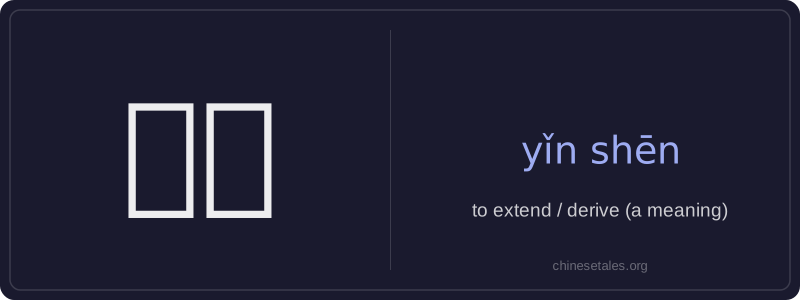
引申 (yǐn shēn) is a verb meaning 'to extend' or 'to derive (a meaning)' — especially in the context of language, logic, or abstract thinking. The character 引 means 'to draw, lead, or pull', suggesting movement or direction; 申 means 'to state, explain, or elaborate', often implying expansion or clarification. Together, they convey the idea of drawing out a new meaning from an existing one — like stretching a concept beyond its original sense, as when a word acquires a figurative or metaphorical usage.
This term is commonly used in linguistics, education, and critical reasoning. It appears frequently in discussions about word evolution (e.g., how 'mouse' came to mean a computer device), literary interpretation, or logical inference. It’s formal but not overly academic — appropriate in textbooks, essays, or thoughtful conversation, though rarely in casual speech. Note that 引申 is almost always transitive and typically followed by a noun phrase indicating what is being extended (e.g., 引申义 'extended meaning') or a clause introduced by '为' or '出'.
Example Sentences
Related Words
面条
‘面条’ (miàn tiáo) literally means ‘flour str
背后
背后 literally means 'back + behind' and functions
认同
‘认同’ (tóng rèn) is a verb meaning ‘to ident
无论谁
‘无论谁’ (wú lùn shéi) is a pronoun meaning
中学
'Zhōngxué' literally combines 'zhōng' (middle)
外语
‘外语’ literally means ‘outside language’ —
认为
‘认为’ (rèn wéi) is a transitive verb meaning
认可
认可 (rèn kě) is a formal, transitive verb meani