Word Explanation
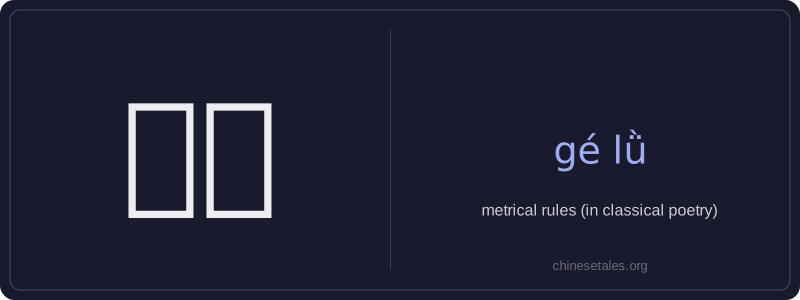
‘格律’ (gé lǜ) refers to the strict metrical and tonal rules governing classical Chinese poetry, especially regulated verse (lüshi) and quatrains (jueju). The character ‘格’ (gé) means ‘pattern,’ ‘standard,’ or ‘form,’ while ‘律’ (lǜ) means ‘law,’ ‘regulation,’ or ‘rhythm.’ Together, they denote the codified system that dictates line length, rhyme scheme, tonal alternation (level vs. oblique tones), and parallelism in couplets — essential features that distinguish formal classical poetry from free verse or prose.
This term is used almost exclusively in literary, academic, or poetic contexts — for example, when studying Tang dynasty poets like Du Fu or Li Bai, or when composing traditional-style poems. It carries a sense of cultural rigor and historical continuity; mastery of gé lǜ is seen as fundamental to authentic classical poetic practice. Modern learners often encounter it in literature courses, calligraphy exhibitions featuring poetry, or workshops on traditional verse composition.
Example Sentences
Related Words
面条
‘面条’ (miàn tiáo) literally means ‘flour str
背后
背后 literally means 'back + behind' and functions
认同
‘认同’ (tóng rèn) is a verb meaning ‘to ident
无论谁
‘无论谁’ (wú lùn shéi) is a pronoun meaning
中学
'Zhōngxué' literally combines 'zhōng' (middle)
见面
见面 literally means 'see face' — combining 见 (t
外语
‘外语’ literally means ‘outside language’ —
认为
‘认为’ (rèn wéi) is a transitive verb meaning