Word Explanation
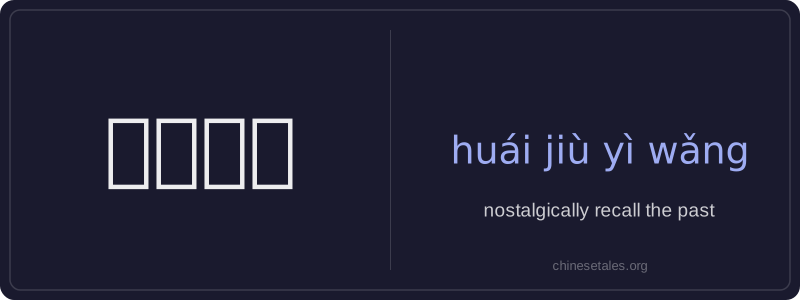
‘怀旧忆往’ is a literary, four-character idiom meaning 'to nostalgically recall the past'—it evokes tender, reflective longing for bygone people, places, or experiences. Each character contributes to this layered sense: 怀 (huái) means 'to cherish in one’s heart'; 旧 (jiù) means 'old' or 'past'; 忆 (yì) means 'to remember'; and 往 (wǎng) refers to 'times gone by' or 'former events'. Together, they form a poetic, slightly formal expression that emphasizes emotional resonance rather than factual recollection.
This phrase is commonly used in written Chinese—such as essays, memoirs, or lyrical songs—and occasionally in spoken contexts when speakers wish to convey warmth and depth of feeling. It often appears with time-related phrases (e.g., ‘儿时’ or ‘青春岁月’) and rarely stands alone; it typically functions as a verb phrase modifying a subject (e.g., ‘他常怀旧忆往’). While not archaic, it carries an elegant, wistful tone distinct from simpler terms like ‘想念’ or ‘回忆’.
Example Sentences
Related Words
面条
‘面条’ (miàn tiáo) literally means ‘flour str
背后
背后 literally means 'back + behind' and functions
认同
‘认同’ (tóng rèn) is a verb meaning ‘to ident
无论谁
‘无论谁’ (wú lùn shéi) is a pronoun meaning
中学
'Zhōngxué' literally combines 'zhōng' (middle)
见面
见面 literally means 'see face' — combining 见 (t
外语
‘外语’ literally means ‘outside language’ —
认为
‘认为’ (rèn wéi) is a transitive verb meaning