Word Explanation
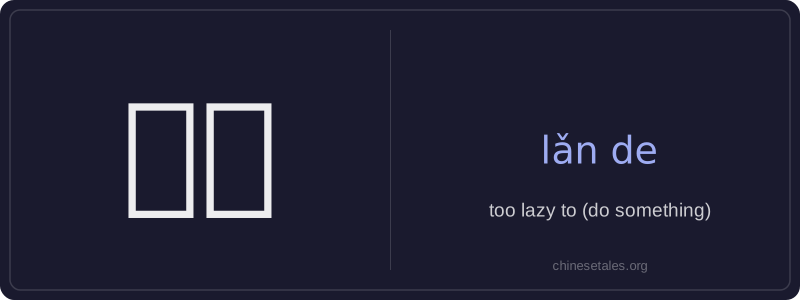
'Lǎn de' is an adverbial phrase meaning 'too lazy to (do something)' — it expresses a lack of motivation or energy to carry out an action, often with a tone of mild self-criticism, resignation, or humorous understatement. The first character 懒 (lǎn) means 'lazy' or 'unwilling', while 得 (de) here is a structural particle indicating potential or willingness (not the result complement 'de'). Together, they form a fixed collocation that always precedes a verb and implies the subject considers the action not worth the effort.
This phrase is common in informal spoken Chinese and appears frequently in daily conversations about chores, study, social obligations, or minor tasks. It carries a subjective, colloquial flavor — you wouldn’t use it in formal writing or official speech. It’s typically used with first-person subjects ('I', 'we') or sometimes second-person in teasing contexts, but rarely with third-person unless narrating informally. Unlike standalone adjectives, 'lǎn de' cannot function as a predicate without a following verb — it must be followed by an action.
Example Sentences
Related Words
面条
‘面条’ (miàn tiáo) literally means ‘flour str
背后
背后 literally means 'back + behind' and functions
认同
‘认同’ (tóng rèn) is a verb meaning ‘to ident
无论谁
‘无论谁’ (wú lùn shéi) is a pronoun meaning
中学
'Zhōngxué' literally combines 'zhōng' (middle)
见面
见面 literally means 'see face' — combining 见 (t
外语
‘外语’ literally means ‘outside language’ —
认为
‘认为’ (rèn wéi) is a transitive verb meaning