妈
Character Story & Explanation
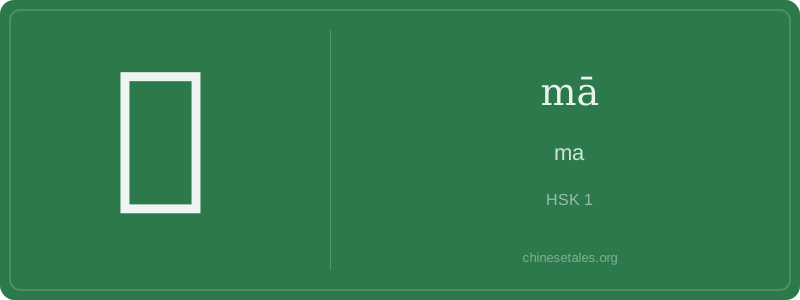
The earliest form of 妈 appears in seal script (c. 3rd century BCE), not oracle bones — because the character didn’t exist yet. It emerged later as a phonetic loan: scribes borrowed the shape of 马 (horse), already well-established and easy to write, then added the 女 radical to specify 'female person sounding like mǎ'. Visually, it’s elegant efficiency: three strokes for 女 (two dots and a curved line suggesting a kneeling woman’s silhouette), three more for 马 (simplified from a complex horse pictograph to just a box with a tail-stroke). Over centuries, the top dot of 女 fused with the roof-like stroke of 马, smoothing into today’s clean six-stroke form.
This wasn’t just linguistic laziness — it was social pragmatism. As Classical Chinese evolved, spoken vernacular needed accessible, quick-to-write kinship terms. 妈 filled that gap perfectly: short, tonally distinct, and visually anchored in womanhood. By the Tang dynasty, it appeared in informal letters and poetry as a tender, intimate address — notably in Bai Juyi’s laments for his mother, where 妈 (in later manuscript variants) conveys raw, personal grief absent from formal texts. Its simplicity hides deep intention: every stroke says 'this is not just any woman — this is the one who raised you.'
At its heart, 妈 (mā) is the warm, familiar, slightly breathy word for 'mom' — not the formal 母 (mǔ) or literary 母亲 (mǔqīn), but the one you yell across the kitchen, whisper into a phone call, or scribble in a birthday card. It’s a phonetic-semantic compound: the left side 女 (nǚ, 'woman') tells you it’s about a female person, and the right side 马 (mǎ, 'horse') gives the sound — though with a crucial tone shift from fourth to first tone. This tone change is non-negotiable: say mǎ instead of mā, and you’re suddenly praising your mom’s equestrian skills — or worse, confusing her with a startled horse.
Grammatically, 妈 is almost always used as a standalone noun or vocative ('Mom!'), rarely modified directly (you wouldn’t say *big mom* — that’s 大妈 dàmā, a different social role entirely). It’s also the base for affectionate reduplications like 妈妈 (māma), which adds softness and childlike intimacy — think of how English says 'mama' before 'mother'. Learners often overuse 妈 when speaking to older women; remember: it’s reserved for your own mother or very close maternal figures, never strangers or elders outside the family.
Culturally, 妈 carries unspoken weight: it’s the first word many Chinese children master, and its pronunciation reflects the universal infant vocalization /ma/, found across languages. Yet in formal writing or respectful address (e.g., to a teacher’s mother), you’d default to 母亲. A classic mistake? Writing 马 instead of 妈 — skipping the 女 radical entirely — which erases the human, gendered meaning and leaves only 'horse'. The radical isn’t decoration: it’s the anchor of identity.