您
Character Story & Explanation
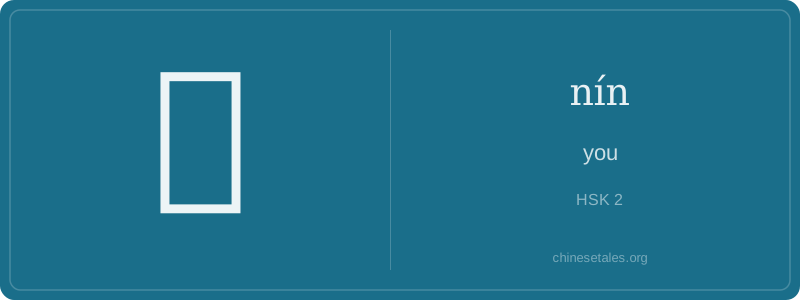
The character 您 evolved from a fusion of 你 (nǐ, ‘you’) and 心 (xīn, ‘heart’). Oracle bone and bronze scripts had no direct precursor for 您 — it’s a later invention, first appearing in Song dynasty texts as a respectful variant. Visually, it stacks 你 (seven strokes: 亻+尔) on top of 心 (four strokes), totaling 11 strokes — a deliberate upgrade: the ‘person’ radical + ‘you’ + ‘heart’ beneath, literally ‘you with heart’. Over centuries, the top 尔 (ěr, ‘you/that’) simplified, and the bottom 心 gained its characteristic dot-and-hook shape, anchoring the whole character in emotional intention.
This visual merger reflects its semantic birth: during the Ming and Qing dynasties, literati began adding 心 to 你 to signal sincerity in formal letters and official documents. By the 20th century, 您 became standard in spoken Mandarin for polite address — especially in northern dialects, later codified in Putonghua. Classical texts rarely used it; Confucius wrote 你 in Analects manuscripts (though those were reconstructed), but modern respect culture made 您 indispensable. Its heart isn’t decorative — it’s the moral core: respect isn’t performative, it’s felt.
Think of 您 (nín) as Mandarin’s ‘royal you’ — like when British royalty says ‘we’ instead of ‘I’, but flipped: one character that carries the weight of an entire honorific system. It doesn’t mean ‘you’ in a neutral sense — it’s always warm, deferential, and socially calibrated, like handing someone a cup of tea with both hands. Unlike English, where ‘you’ is universal (‘you’re welcome’, ‘you suck’, ‘you, sir!’), Chinese splits this into two: 你 (nǐ) for friends, peers, or kids; 您 for elders, teachers, strangers you want to impress, or anyone whose status or age invites respect.
Grammatically, 您 behaves exactly like 你 — same verb endings, same sentence structure — so ‘您好吗?’ (Nín hǎo ma?) means ‘How are you?’, just more polished. But swap in 你 by accident with your boss or grandma? It’s not wrong, per se — but feels like showing up to a wedding in flip-flops: technically functional, culturally jarring. Learners often overuse 您 (e.g., with classmates), or underuse it (e.g., texting a professor ‘你好’ instead of ‘您好’), missing subtle social cues baked into every interaction.
Culturally, 您 isn’t about hierarchy alone — it’s relational care. In Beijing taxi cabs, drivers say 您 to all passengers; in Shanghai, shopkeepers use it even with teens buying bubble tea. It’s less ‘I submit to your authority’ and more ‘I hold space for your dignity’. And yes — it’s HSK 2, but its emotional precision makes it far more advanced than its level suggests.