息
Character Story & Explanation
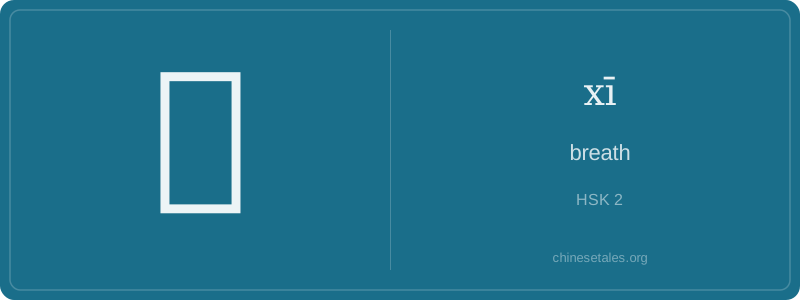
The earliest form of 息 appears in bronze inscriptions as a combination of 自 (zì, ‘nose’) on top and 心 (xīn, ‘heart’) below — a literal ‘nose-heart’, visualizing breath entering through the nose and settling in the heart-mind. Over centuries, 自 simplified into the top component that now looks like 自 but stylized (⺈ + 日), while 心 remained beautifully intact at the base — 10 strokes total, counting each deliberate curve of the heart radical. This wasn’t abstract philosophy: it was anatomy-meets-awareness — ancient scribes literally drawing how breath connects perception (nose) and feeling (heart).
This bodily logic shaped its meaning evolution: from physical breathing → vital life force → news (what ‘travels on breath’, like rumors whispered from mouth to mouth) → interest (as ‘what grows quietly over time’, like breath ripening into energy). By the Han dynasty, 息 appeared in the *Shuōwén Jiězì* dictionary defined as ‘to stop and rest one’s breath’, linking pause, recovery, and renewal. Even today, when Chinese say ‘平息风波’ (píng xī fēng bō — ‘calm the storm’), they’re invoking that ancient image: stilling the inner breath to still the outer chaos.
At its heart, 息 (xī) is about rhythm — the quiet rise and fall of breath, the pause between thoughts, the stillness before action. It’s not just ‘breath’ as air in lungs; it’s the *vital pulse* of life and energy: when you rest, you ‘rest your breath’ (休息); when news spreads, it ‘spreads like breath’ (消息). That’s why 息 feels intimate and organic — never mechanical. You don’t ‘take’ 息 like a pill; you *let it settle*, *hold it*, or *lose it* (气喘吁吁, 心跳加速).
Grammatically, 息 is rarely used alone — it’s almost always in compounds (e.g., 信息, 消息, 呼吸). As a verb, it appears only in fixed phrases like 休息 (to rest) or 息怒 (to calm down), where it carries a gentle, almost literary weight. Learners often mistakenly try to say ‘I breathe’ using 息 alone — but that’s wrong! You say 我在呼吸 (wǒ zài hū xī), not *我在息. Also, avoid over-translating 息 as ‘息’ in English — it’s never ‘息’ in isolation, just like we don’t say ‘I’m doing breath’ in English.
Culturally, 息 reflects a Daoist and medical worldview: breath is inseparable from qi (vital energy) and emotional state. In classical texts, 息 often signals equilibrium — e.g., 《庄子》says ‘真人之息以踵’ (‘The true person’s breath reaches the heels’), implying deep, grounded vitality. A common learner trap? Confusing 息 with similar-looking characters like 息 vs. 思 or 息 vs. 息’s near-twin 息 vs. 息’s lookalike 息 — wait, no — see the ‘similar’ section! The key is remembering: 心 (heart-mind) at the bottom means this breath lives in your body *and* your spirit.