针
Character Story & Explanation
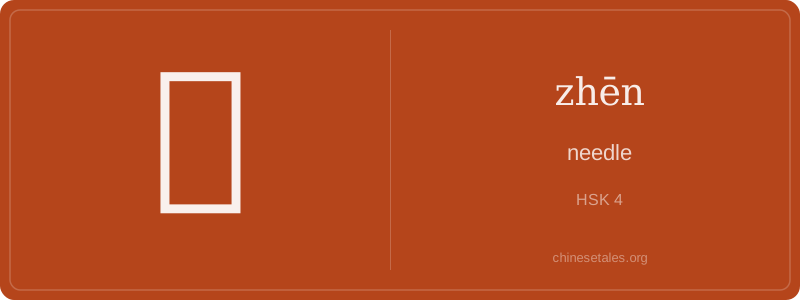
The earliest form of 针 appears in bronze inscriptions around 1000 BCE—not as a full pictograph, but as a phonetic-semantic compound. Its right side, 戋 (jiān), was already a simplified depiction of two small blades or cutting tools, suggesting sharpness and division; its left side, 金 (jīn, ‘metal’), was later abbreviated to 钅 (the ‘metal’ radical) to indicate material. Originally, the character emphasized *metallic sharpness*: early forms show 戋 above 金, evolving into today’s left-radical-right-phonetic structure. Notice how the 7 strokes flow downward—like a needle piercing fabric: the top dot (丶) is the eye, the vertical stroke (丨) the shaft, and the three short strokes on the right (戋) mimic the tapered tip and barbs.
By the Han dynasty, 针 had shifted from merely ‘pointed metal tool’ to encompass medical, textile, and even astronomical uses—Han texts describe ‘star needles’ (星针) for celestial navigation. The character’s semantic range widened precisely because of its core trait: *precision at scale*. In the Shuō Wén Jiě Zì (121 CE), Xu Shen defined it as ‘a fine, pointed instrument made of metal for threading’, highlighting function over form. Crucially, its visual economy—just 7 strokes for such conceptual weight—mirrors the Confucian ideal of ‘great meaning in few words’, making it a quiet masterpiece of functional calligraphy.
Imagine your grandmother leaning over a worn wooden table, her silver hair catching the afternoon light as she threads a tiny, gleaming zhēn—not just any needle, but *the* needle: precise, indispensable, almost alive in its purpose. In Chinese, 针 isn’t just a sewing tool—it’s the symbol of focused action, sharp attention, and delicate intervention. It carries a quiet authority: you wouldn’t say ‘I used a needle’ casually—you’d say tā yòng zhēn fēng le kùzi (she sewed the pants with a needle), where 针 appears as a direct object noun, often preceded by a measure word like yì gēn (one root/stick) because it’s slender and rigid.
Grammatically, 针 is a countable noun that rarely stands alone—it’s almost always modified (xì zhēn, fine needle; yī zhēn, medical needle) or embedded in compounds (zhēn jiǔ, acupuncture). Learners often mistakenly use it as a verb (‘to needle’)—but Chinese uses verbs like cì (to prick) or zhēn zhì (to treat with acupuncture), not 针 itself. Also, never omit the measure word: saying *‘wǒ yào zhēn’* sounds like ‘I want a needle’—but without yì gēn, it’s grammatically jarring, like saying ‘I want spoon’ in English.
Culturally, 针 evokes both domestic care and clinical precision—two realms bound by the same principle: small tools wield great influence. In idioms like xiǎo zhēn cáng dà ài (a small needle hides great love), it symbolizes quiet, meticulous devotion. And yes—despite its tiny size, it’s HSK 4 because it appears in critical health, craft, and metaphorical contexts (e.g., zhēn duì xìng, ‘targetedness’), where nuance matters more than frequency.