险
Character Story & Explanation
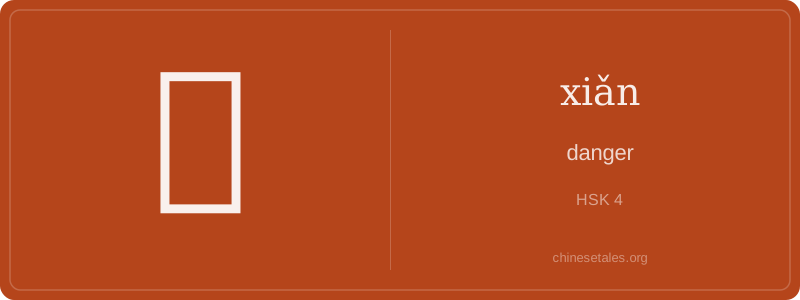
The earliest form of 险 appears in bronze inscriptions as a combination of 阜 (fù, ‘mound’ or ‘hill’, later simplified to the left-side 阝 radical) and 僉 (qiān, a phonetic component meaning ‘together’ but here serving sound only). Visually, the ancient version showed a steep slope with jagged contours — think craggy cliffs leaning precariously — and the phonetic part anchored its pronunciation. Over centuries, the mound radical condensed into the modern left-side ear radical (阝), while 僉 streamlined into the right-side 佥, losing its original ‘crowd’ meaning but preserving the xiǎn sound.
This character first appeared in texts like the *Zuo Zhuan*, where ‘xiǎn dì’ meant ‘treacherous terrain’ — crucial for warfare and travel. Its meaning expanded from literal topography (steep, unstable land) to metaphorical peril (political 险, moral 险) by the Han dynasty. Interestingly, the radical 阝 on the left signals ‘terrain-related’, linking 险 directly to geography — which explains why it’s so often paired with words like ‘shān’ (mountain) or ‘dì’ (land). The visual weight of its nine strokes — especially the sharp, downward-sweeping final stroke of 佥 — mirrors the feeling of slipping off a cliff edge.
Imagine you’re hiking the Tiger Leaping Gorge in Yunnan — sheer cliffs drop 3,000 meters, mist swirls like ghost fingers, and your guide points to a narrow path carved into the rockface, whispering, ‘Zhè lǐ hěn xiǎn.’ That’s 险: not just ‘danger’ as abstract risk, but visceral, physical peril — steep, unstable, edge-of-the-abyss danger. It carries tension, urgency, and often implies *avoidable* hazard (not fate). You’ll hear it in warnings (‘xiǎn!’), news reports (‘jiāotōng xiǎn’), or even irony (‘tā bǎ shēngmìng dāng wánxiào — zhēn xiǎn!’).
Grammatically, 险 is almost always a noun or adjective — never a verb. Learners mistakenly try ‘xiǎn le’ for ‘became dangerous’, but that’s wrong; use ‘biàn xiǎn’ or ‘yǒu xiǎn’. It pairs naturally with adverbs like hěn, jí, or yǒu (yǒu xiǎn = ‘risky’), and appears in set phrases like ‘huà xiǎn wéi yí’ (turn danger into safety). Note: it rarely stands alone — you’ll almost always see it modified (wēixiǎn, xiǎnxiàng) or in compounds.
Culturally, 险 evokes Daoist and military classics — Sun Tzu wrote that ‘zhī yǐ zhī bǐ, bǎi zhàn bù dài’ (know enemy and self), but also stressed reading terrain’s 险 — slopes, chokepoints, hidden traps. Modern usage still reflects this: ‘dìlǐ huánjìng hěn xiǎn’ isn’t just ‘geography is dangerous’ — it means ‘the land itself conspires against you’. A common mistake? Using 险 where English says ‘risky’ in casual contexts — native speakers prefer ‘bù tài ānquán’ or ‘yǒu fēngxiǎn’ instead of bare 险.