验
Character Story & Explanation
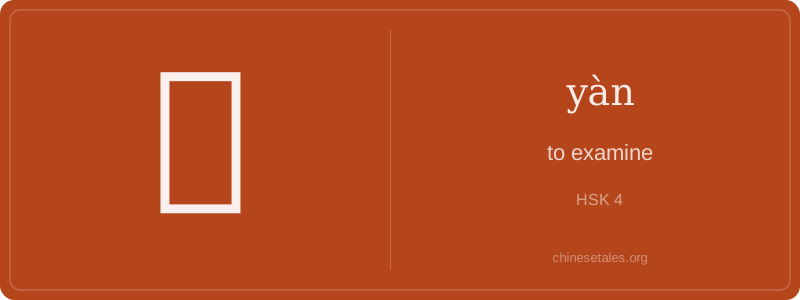
The earliest form of 验 appears in seal script (c. 3rd century BCE), where it combined 馬 (mǎ, ‘horse’) — the radical — with 奄 (yǎn, ‘to cover, suppress’) as the phonetic component. Wait — why a horse? Because in ancient China, verifying a horse’s pedigree, age, and fitness was critical for military and trade. Inspectors would literally examine horses, checking teeth, gait, and markings — turning ‘horse inspection’ into a metaphor for rigorous verification. The modern shape preserves the left-side 马 (simplified from traditional 馬) and right-side 奄 (now written as 佥, a stylized variant), totaling 10 strokes.
By the Han dynasty, 验 broadened beyond livestock to mean ‘confirming truth through evidence’, appearing in legal texts like the *Book of Han* (《汉书》) to describe validating testimony or documents. Its visual logic remains intact: the ‘horse’ radical anchors it in concrete, physical examination, while the ‘covering/suppressing’ element hints at the act of controlling uncertainty — putting doubt to rest by confronting facts head-on. This duality — animal rigor + human judgment — still pulses in every modern usage.
At its heart, 验 (yàn) isn’t just ‘to examine’ — it’s about *verification through evidence*, a deeply Chinese value rooted in trust built on observable proof. Think less ‘glance at’ and more ‘put under scrutiny to confirm authenticity’. You’ll see it everywhere: verifying ID cards (验身份证), checking QR codes (验码), or confirming test results (验血). It implies a gatekeeper role — something must pass inspection before proceeding.
Grammatically, 验 is almost always transitive and appears in compound verbs (e.g., 验证, 检验, 测验) or as the main verb in formal or procedural contexts. You rarely say ‘I yàn this book’ — instead, you ‘verify a claim’ (验证说法) or ‘undergo an inspection’ (接受检验). Note: it’s not used for casual observation (that’s 看 or 观察); learners often wrongly substitute it for ‘check’ in informal speech like ‘Let me check my phone’ — that’s 查 or 看, never 验.
Culturally, 验 reflects China’s institutional emphasis on documentation and due diligence — from health-code scanning to academic credential verification. A common mistake? Overusing it where English says ‘check’ — but in Chinese, ‘checking’ your email is 查收, not 验收. Also, be careful with tone: yàn (4th) is distinct from yán (2nd, e.g., 言), and confusing them breaks meaning entirely.