闹
Character Story & Explanation
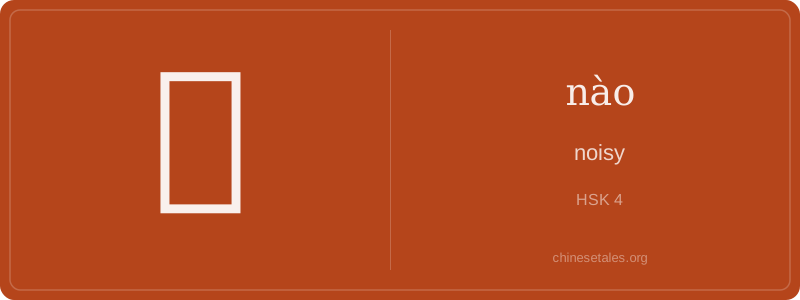
The earliest form of 闹 appears in seal script (c. 3rd century BCE) as a compound: the outer frame 门 (mén, ‘gate’) enclosing 冗 (rǒng, ‘redundant; superfluous’ — originally depicting a person with extra clothing folds). Visually, it evoked people crowding *inside* a gate — jostling, overlapping, overflowing the boundary. Over centuries, 冗 simplified into 市 (shì, ‘market’) in clerical script, then further streamlined to the modern 灬 (fire radical) + 市 look-alike — though today’s lower part is actually a stylized variant of 冗, not fire. The door frame remained intact, preserving the idea of confined space bursting at the seams.
This visual logic shaped its semantic journey: from literal ‘crowded gate’ → ‘boisterous market’ → ‘commotion’ → ‘to stir up trouble’. In classical texts like the *Dream of the Red Chamber*, 闹 appears in phrases like 闹得不可开交 (nào de bùkě kāijiāo, ‘so chaotic it can’t be untangled’), cementing its link to social turbulence. Even today, the character’s shape whispers: *a doorway full of restless energy — about to spill out.*
At its core, 闹 (nào) isn’t just ‘noisy’ — it’s *chaotic energy made audible*. Think of a crowded market at dawn: shouting vendors, clanging woks, barking dogs, kids chasing pigeons — that’s the visceral, slightly unruly vibe 闹 carries. It implies not just sound, but *disruption*, *commotion*, or even *making a fuss*. Unlike quiet adjectives like 安静 (ānjìng), 闹 is active and often judgment-adjacent: saying 这里太闹 (zhè lǐ tài nào) isn’t neutral — it’s a polite complaint.
Grammatically, 闹 shines as an adjective (e.g., 闹市 — nàoshì, ‘bustling downtown’) and a verb meaning ‘to cause trouble’ or ‘to pester’ — especially in colloquial speech: 别闹!(Bié nào! — ‘Stop it!’ / ‘Don’t be silly!’). It also appears in fixed expressions like 闹笑话 (nào xiàohua, ‘to make a fool of oneself’) — where it conveys unintended, embarrassing commotion. Learners often mistakenly use it like English ‘loud’, but 闹 implies *social friction*, not volume alone — you wouldn’t say 闹的音乐 (nào de yīnyuè); you’d say 大声的音乐 (dàshēng de yīnyuè).
Culturally, 闹 carries playful weight — in folk traditions like 闹社火 (nào shèhuǒ), ‘lively lantern festivals’, or 闹洞房 (nào dòngfáng), ‘roasting newlyweds’ — where noise equals joy, blessing, and communal participation. Misusing it as a simple synonym for ‘loud’ misses this cultural warmth — and risks sounding overly critical or tone-deaf.