少
Character Story & Explanation
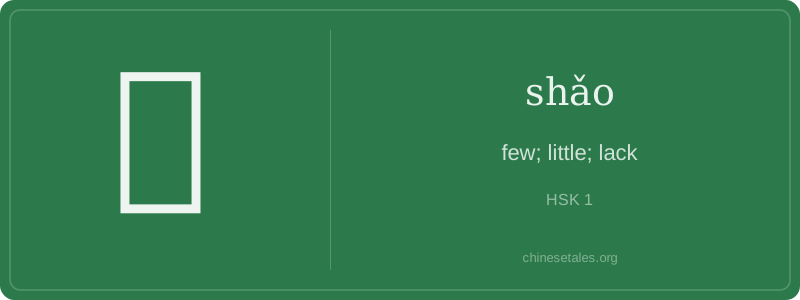
The earliest form of 少 appears in oracle bone inscriptions as three tiny dots above a simplified 'small' (小) — visually echoing falling raindrops or scattered grains. Over time, those dots fused into the top stroke (丿), while the lower 'small' (小) remained intact — creating today’s four-stroke structure: 丿 + 小. This wasn’t arbitrary: ancient scribes used minimal strokes to express minimal quantity — the fewer the marks, the fewer the things. Even the radical 小 (xiǎo, 'small') anchors its meaning: 少 isn’t just 'not big' — it’s 'small-ness made measurable.'
By the Warring States period, 少 had expanded beyond pure quantity to imply moral restraint — Mencius wrote 少则得,多则惑 ('With little, one gains; with much, one is confused'). Its dual pronunciation (shǎo/shào) emerged later: shào entered the language through classical compounds like 少年 (shàonián, 'young person'), where it evokes youthfulness — not scarcity, but potential held in reserve, like a bud not yet opened. Visually, the character’s lightness — only four strokes, no heavy components — mirrors its semantic role: it’s the linguistic whisper in a language of bold strokes.
Think of 少 (shǎo) as the Chinese equivalent of the English word 'scant' — not quite empty, but definitely not full. It’s the quiet voice in a crowded room saying, 'There’s just a little left,' or 'Not many people came.' Unlike English adjectives that change form (few/fewer/fewest), 少 stays stubbornly the same — but its meaning shifts dramatically depending on position: before a noun it means 'few/little' (少钱 shǎo qián — 'little money'), while after 很 (hěn) it becomes a comparative ('less than') — e.g., 他比我少两岁 (Tā bǐ wǒ shǎo liǎng suì, 'He is two years younger than me').
Grammatically, it’s deceptively simple — yet learners often misplace it or confuse it with 不多 (bù duō, 'not much'), which is softer and more conversational. Crucially, 少 is never used alone as a noun ('a few') like some — you’ll always see it modifying something: 少人 (shǎo rén), 少时间 (shǎo shíjiān). And remember: when it appears in words like 少年 (shàonián, 'youth'), the pronunciation flips to shào — a subtle cue that you’ve stepped into classical or formal territory.
Culturally, 少 carries quiet moral weight: Confucius praised moderation (少私寡欲 — 'few private desires'), and modern Mandarin still uses 少 to imply prudence — 'eat less,' 'speak less,' 'spend less.' A common mistake? Using 少 for 'not enough' — that’s actually 不够 (bù gòu). 少 describes quantity; 不够 describes sufficiency. Mix them up, and your polite request for 'a little more tea' could accidentally sound like 'there’s barely any tea left!'