享
Character Story & Explanation
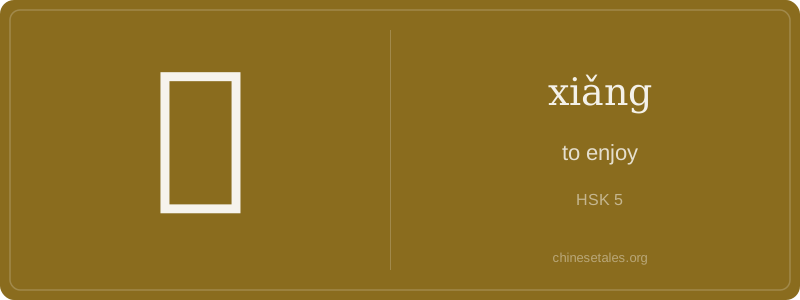
The earliest form of 享 appears on Shang dynasty oracle bones as a stylized altar or sacrificial platform — a square base topped with a roof-like structure (the 亠 radical), with lines suggesting offerings placed beneath it. Over centuries, the lower part simplified: bronze inscriptions added two horizontal strokes (一) and two verticals (丨), evolving into the modern 口 + 亠 + 丷 structure. The top 亠 (tóu) represents a ceremonial canopy; the inner 口 suggests containment — a sacred space; the flanking 丷 resembles hands holding offerings upward. Every stroke is ritual architecture.
This visual origin explains why 享 never meant 'eat' or 'taste' alone — it meant 'present offerings *and* receive blessings in return.' In the Book of Rites, it appears in contexts like '以享先王' (to offer sacrifices to former kings). By the Han dynasty, its meaning broadened to 'enjoy the fruits of virtue' — hence classical phrases like 享国 (to reign and benefit from sovereignty). Even today, when we say 享有权利, we echo that ancient idea: rights are not seized, but ritually received and upheld.
Imagine you’re at a family banquet in Suzhou — steaming xiaolongbao, fragrant osmanthus wine, elders smiling as they lift their cups. Someone says, '大家请享用了!' (Dàjiā qǐng xiǎngyòng le!) — not just 'please eat,' but 'please *enjoy* this moment, this offering, this shared blessing.' That’s 享: it’s never just passive consumption; it’s mindful, respectful, even sacred enjoyment — of food, time, rights, or legacy. It carries warmth and weight, like receiving a gift with both hands.
Grammatically, 享 is nearly always transitive and formal. You don’t 'xiǎng a movie' — that’s 看 (kàn). You *xiǎng* privileges (享有), benefits (享受), or ancestral rites (享祭). It pairs with verbs like 有 (to have) or 惠 (favor), or appears in set phrases like 享有盛誉 (to enjoy great prestige). Learners often misuse it as a casual synonym for 'like' or 'love' — but 享 never means 'I enjoy hiking'; it’s 'citizens enjoy healthcare coverage' — institutional, collective, or ceremonial.
Culturally, 享 echoes ancient ritual: the character originally depicted offerings to ancestors, and today it still implies reciprocity and reverence. Mispronouncing it as xiáng (a common slip) risks sounding archaic or poetic — and using it where 分享 (fēnxiǎng, 'to share') fits better turns your sentence from 'we share joy' into 'we ritually partake of joy,' which feels oddly solemn at a birthday party!