仿
Character Story & Explanation
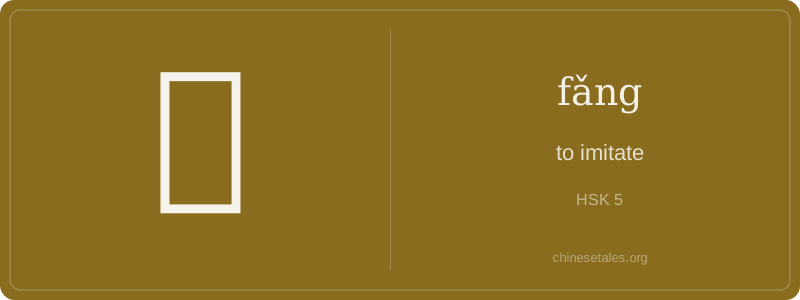
The earliest form of 仿 appears in seal script (c. 3rd century BCE), combining the radical 亻 (person) on the left and 方 (fāng, meaning ‘square,’ ‘method,’ or ‘direction’) on the right. It wasn’t pictographic but semantic-phonetic: 亻 signals human action, while 方 served both as sound clue (ancient pronunciation was close to *bâŋ) and meaning carrier — suggesting ‘following a prescribed method’ or ‘acting in accordance with a standard.’ Stroke evolution simplified the bronze-script 方 into its modern six-stroke shape: two horizontal lines, a dot, then two connected verticals — a tidy, balanced ‘square’ echoing order and model.
This structure reflects how the concept matured: in the Book of Rites, 仿 describes ritual behavior modeled after sages; by the Tang dynasty, it governed artistic practice — painters were expected to 仿 the masters before innovating. The visual symmetry of the character itself mirrors its core idea: imitation as a disciplined, centered act — not haphazard copying, but stepping deliberately into another’s footsteps to learn their stride.
At its heart, 仿 isn’t just ‘to copy’ — it’s about respectful imitation with intent. In Chinese thought, imitation isn’t a sign of weakness or lack of originality; it’s the essential first step in mastery — whether learning calligraphy from a master’s hand, emulating a virtuous elder’s conduct, or replicating ancient ceramic glazes in Jingdezhen kilns. The character carries quiet reverence: you don’t 仿 just anything — you 仿 what’s worthy, established, or exemplary.
Grammatically, 仿 is most often a transitive verb followed by an object (e.g., 仿古 ‘imitate antiquity’) or used in serial verb constructions like 仿照…制作 (‘imitate according to… and make’). Crucially, it’s rarely used alone as an imperative — you wouldn’t say *‘仿!’ like ‘Copy!’ in English. Instead, it appears embedded: 他仿王羲之的字写了一幅对联 (He wrote a couplet imitating Wang Xizhi’s calligraphy). Learners often overuse it where 模仿 (more neutral/colloquial) or 复制 (mechanical duplication) would fit better — 仿 implies aesthetic or cultural alignment, not just replication.
Culturally, 仿 reveals a deep Confucian value: growth through emulation. Unlike Western individualism that prizes ‘breaking the mold,’ Chinese pedagogy honors tracing the master’s brushstroke before forging your own. That’s why 仿 appears in phrases like 仿生学 (bionics — ‘imitating life’) and 仿古建筑 (architectural revivalism) — always with purpose, precedent, and a nod to lineage.