伴
Character Story & Explanation
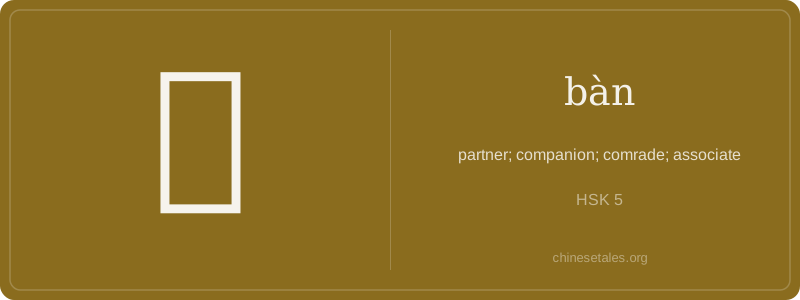
The earliest form of 伴 appears in bronze inscriptions around 1000 BCE: a person radical (亻) paired with 半 (bàn, ‘half’), written as + 半. The original pictograph wasn’t literal — it visualized symmetry: two halves forming one whole. Imagine two dancers mirroring each other’s moves — not identical, but interdependent. Over centuries, the left side standardized into 亻 (the ‘person’ radical), while 半 simplified from its ancient form (a knife cutting a ‘ten’ unit) into today’s clean, balanced 8-stroke shape — though 伴 itself has only 7 strokes total (2 for 亻 + 5 for 半).
This ‘two halves’ concept deeply shaped its meaning. In the *Book of Songs* (Shījīng), 伴 describes loyal ministers ‘accompanying’ the ruler like a shadow — not subservient, but co-essential. By the Tang dynasty, poets like Wang Wei used 伴 to evoke quiet fellowship: ‘松风伴我眠’ (sōng fēng bàn wǒ mián, ‘pine breezes accompany my sleep’) — where nature becomes an intimate, gentle companion. The stroke count (7) even echoes this duality: two people (亻 = 2 strokes) plus five for 半 — a subtle reminder that true companionship requires both presence (2) and shared space (5).
At its heart, 伴 (bàn) isn’t just ‘someone who’s with you’ — it’s about *intentional, reciprocal presence*. Think of it as the Chinese linguistic equivalent of holding someone’s hand while walking: equal, voluntary, and emotionally attuned. Unlike passive words like ‘with’ (跟 or 和), 伴 carries warmth and agency — you *choose* to 陪伴 (bànmíng) someone, especially in times of need or joy. It’s rarely used for casual acquaintances; a coworker you sit next to isn’t your 伴 — but your study partner who reviews HSK 5 flashcards with you? Absolutely.
Grammatically, 伴 is most common as a noun (‘companion’) or in the verb form 陪伴 (bànmíng, ‘to accompany’). Learners often mistakenly use 伴 alone as a verb (e.g., ×我伴你 — incorrect), but native speakers say 我陪你 (wǒ péi nǐ). Also watch tone: bàn is fourth tone — not the rising second tone of 办 (bàn, ‘to handle’) or the neutral tone of 半 (bàn, ‘half’). Confusing them leads to hilarious or awkward slips!
Culturally, 伴 reflects Confucian ideals of relational harmony: companionship isn’t incidental — it’s a moral practice. In classical texts, 伴 appears in contexts like ‘良师益友为伴’ (liáng shī yì yǒu wéi bàn, ‘to take virtuous teachers and helpful friends as companions’), underscoring that good company shapes character. A common mistake? Overusing 伴 for romantic partners — while possible (e.g., 爱人 or 恋人 are more precise), 伴 sounds poetic or formal there, like calling your spouse ‘my lifelong companion’ instead of ‘my husband.’