俊
Character Story & Explanation
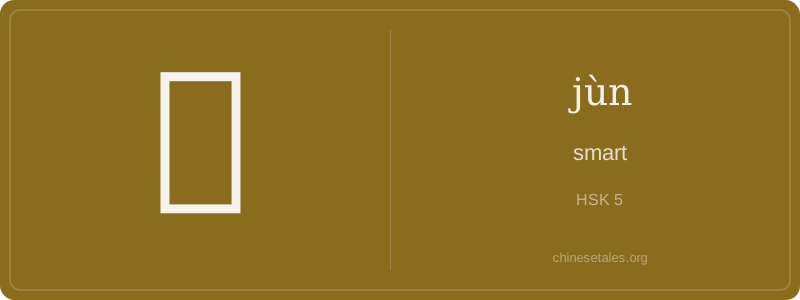
The earliest form of 俊 appears in bronze inscriptions as a combination of 人 (rén, ‘person’) and 夋 (qūn, a now-obsolete character depicting a person with long, flowing hair and an upright posture — symbolizing distinction and grace). The left radical 亻 (‘person’) anchors it socially; the right component 夋 evolved into 峻 (jùn, ‘steep, lofty’) — hinting at elevation, both physical and moral. Over centuries, 夋 simplified: its top stroke became the horizontal line above the ‘X’ shape, and the lower legs merged into the final 丶 (dot) and 乚 (curved stroke), yielding today’s clean, balanced nine-stroke form.
This visual journey mirrors its semantic arc: from ‘a person distinguished by bearing’ (Zhou dynasty bronze texts) to ‘a person distinguished by talent and virtue’ (Warring States *Mencius*, where 俊 is paired with ‘sages’ and ‘heroes’). By the Tang, 俊 crystallized as the mark of elite literati — not raw smarts, but cultivated excellence. Its association with beauty (as in 俊俏) emerged later, reinforcing how Chinese tradition links moral intelligence with aesthetic harmony — mind and face both ‘well-proportioned.’
At its heart, 俊 isn’t just ‘smart’ — it’s *refined brilliance*: the kind that combines sharp intellect with graceful presence and moral poise. Think of a scholar-official in Tang dynasty poetry — not just clever, but dignified, articulate, and effortlessly impressive. That’s the vibe of 俊. It’s an adjective (always modifying nouns), never used predicatively like ‘He is smart’ — you’d say 他很聪明 (tā hěn cōngmíng), not 他很俊. Instead, 俊 appears in set phrases or descriptive compounds: 俊才 (jùn cái, ‘outstanding talent’), 俊杰 (jùn jié, ‘eminent person’), or as part of names (e.g., 李俊, Lǐ Jùn).
Grammatically, 俊 rarely stands alone — you won’t hear ‘This student is 俊.’ It’s almost always embedded: in literary adjectives (俊美 jùn měi, ‘handsome and refined’), honorific titles (俊彦 jùn yàn, ‘distinguished scholars’), or classical-style compound nouns. Learners often mistakenly use it like 聪明 or 智慧, but 俊 carries aristocratic, almost aesthetic weight — more ‘luminous intellect’ than ‘IQ score.’ Also beware: while jùn is standard, zùn survives only in archaic texts (like the *Shuōwén Jiězì*) meaning ‘to gather’ or ‘to select,’ unrelated to intelligence — so ignore zùn unless reading Han dynasty lexicography!
Culturally, 俊 evokes Confucian ideals: wisdom inseparable from virtue and elegance. In the *Analects*, Confucius praises ‘junzi’ (gentlemen) whose intelligence is tempered by ritual (lǐ) and benevolence (rén) — 俊 is the lexical cousin of that ideal. Modern usage leans poetic or formal: news headlines call reformers ‘时代俊杰’, not ‘smart leaders.’ Overusing it sounds stiff or mock-classical — like calling your barista a ‘paragon of erudition’ instead of ‘great at espresso.’